

What If Inanimate Objects And Animals Could Speak


Dehumanization is the denial of full humanness in others and the cruelty and suffering that accompanies information technology.[1] [ii] [three] A practical definition refers to it as the viewing and handling of other persons as though they lack the mental capacities that are commonly attributed to human beings.[4] In this definition, every human activity or idea that regards a person as "less than" human is dehumanization.[five]
Dehumanization is one technique in incitement to genocide.[6] It has also been used to justify war, judicial and extrajudicial killing, slavery, the confiscation of property, deprival of suffrage and other rights, and to assail enemies or political opponents.
Conceptualizations [edit]

Behaviorally, dehumanization describes a disposition towards others that debases the others' individuality as either an "individual" species or an "individual" object (e.grand., someone who acts inhumanely towards humans). As a procedure, dehumanization may be understood as the opposite of personification, a effigy of spoken communication in which inanimate objects or abstractions are endowed with human qualities; dehumanization then is the disendowment of these same qualities or a reduction to abstraction.[seven]
In virtually all contexts, dehumanization is used pejoratively along with a disruption of social norms, with the former applying to the actor(s) of behavioral dehumanization and the latter applying to the action(southward) or processes of dehumanization. For case, there is dehumanization for those who are perceived as lacking in civilisation or civility, which are concepts that are believed to distinguish humans from animals.[8] Social norms ascertain humane behavior and reflexively define what is outside of humane behavior or inhumane. Dehumanization differs from inhumane behaviors or processes in its breadth to suggest competing social norms. It is an activity of dehumanization equally the old norms are depreciated to the competing new norms, which then redefine the action of dehumanization. If the new norms lose acceptance, and then the action remains one of dehumanization. The definition of dehumanization remains in a reflexive state of a type-token ambivalence relative to both individual and societal scales.
In biological terms, dehumanization can be described equally an introduced species marginalizing the homo species, or an introduced person/process that debases other persons inhumanely.[9]
In political science and jurisprudence, the act of dehumanization is the inferential alienation of homo rights or denaturalization of natural rights, a definition contingent upon presiding international law rather than social norms limited by human geography. In this context, a specialty inside species does non need to found global citizenship or its inalienable rights; the human genome inherits both.
It is theorized that dehumanization takes on two forms: animalistic dehumanization, which is employed on a by and large intergroup basis; and mechanistic dehumanization, which is employed on a by and large interpersonal ground.[10] Dehumanization can occur discursively (e.g., idiomatic language that likens private human being beings to not-man animals, verbal abuse, erasing one's voice from soapbox), symbolically (e.thou., imagery), or physically (e.g., chattel slavery, physical abuse, refusing center contact). Dehumanization often ignores the target's individuality (i.e., the artistic and exciting aspects of their personality) and can hinder i from feeling empathy or correctly understanding a stigmatized group.[11]
Dehumanization may be carried out by a social institution (such every bit a state, schoolhouse, or family), interpersonally, or even within oneself. Dehumanization can be unintentional, specially upon individuals, equally with some types of de facto racism. Country-organized dehumanization has historically been directed confronting perceived political, racial, ethnic, national, or religious minority groups. Other minoritized and marginalized individuals and groups (based on sexual orientation, gender, disability, class, or another organizing principle) are likewise susceptible to various forms of dehumanization. The concept of dehumanization has received empirical attention in the psychological literature.[12] [xiii] It is conceptually related to infrahumanization,[fourteen] delegitimization,[15] moral exclusion,[sixteen] and objectification.[17] Dehumanization occurs across several domains; it is facilitated by status, power, and social connectedness; and results in behaviors similar exclusion, violence, and support for violence against others.
"Dehumanisation is viewed as a central component to intergroup violence considering it is oftentimes the well-nigh of import precursor to moral exclusion, the process by which stigmatized groups are placed outside the boundary in which moral values, rules, and considerations of fairness apply."[18]
David Livingstone Smith, director and founder of The Human Nature Project at the University of New England, argues that historically, human beings accept been dehumanizing one another for thousands of years.[19] In his work "The Paradoxes of Dehumanization", Smith proposes that dehumanization simultaneously regards people every bit human and subhuman. This paradox comes to light, as Smith identifies, because the reason people are dehumanized is so their human attributes can be taken reward of.[20]
Humanness [edit]
In Herbert Kelman's work on dehumanization, humanness has 2 features: "identity" (i.e., a perception of the person "every bit an individual, independent and distinguishable from others, capable of making choices") and "community" (i.e., a perception of the person as "part of an interconnected network of individuals who care for each other"). When a target'southward agency and embeddedness in a community are denied, they no longer elicit compassion or other moral responses and may endure violence.[21]
Objectification of women [edit]
Psychologist Barbara Fredrickson and Tomi-Ann Roberts argued that the sexual objectification of women extends across pornography (which emphasizes women's bodies over their uniquely human being mental and emotional characteristics) to society generally. At that place is a normative emphasis on female appearance that causes women to accept a third-person perspective on their bodies.[22] The psychological altitude women may feel from their bodies might cause them to dehumanize themselves. Some research has indicated that women and men showroom a "sexual body part recognition bias", in which women's sexual body parts are better recognized when presented in isolation than in their entire bodies. In dissimilarity, men's sexual body parts are improve recognized in the context of their entire bodies than in isolation.[23] Men who dehumanize women as either animals or objects are more liable to rape and sexually harass women and display more negative attitudes toward female person rape victims.[24]
Philosopher Martha Nussbaum identified vii components of objectification: instrumentality, denial of autonomy, inertness, fungibility, violability, ownership, and deprival of subjectivity.[25] [ further explanation needed ]
History [edit]
Native Americans [edit]

Mass grave for the expressionless Lakota following the Wounded Knee massacre. Up to 300 Natives were killed, generally old men, women and children.[26]
Native Americans were dehumanized as "merciless Indian savages" in the United states of america Declaration of Independence.[27] Following the Wounded Knee massacre in December 1890, author L. Frank Baum wrote:[28]
The Pioneer has before declared that our only safety depends upon the total extermination [sic] of the Indians. Having wronged them for centuries we had amend, in order to protect our civilization, follow it upward past one more than wrong and wipe these untamed and untamable creatures from the face up of the earth. In this lies safety for our settlers and the soldiers who are under incompetent commands. Otherwise, nosotros may look future years to exist as total of trouble with the redskins as those have been in the past.
In Martin Luther Rex Jr.'s book on civil rights, Why We Can't Wait, he wrote:[29] [30] [31]
Our nation was born in genocide when it embraced the doctrine that the original American, the Indian, was an inferior race. Fifty-fifty earlier in that location were large numbers of Negroes on our shores, the scar of racial hatred had already disfigured colonial society. From the sixteenth century forward, blood flowed in battles over racial supremacy. We are perhaps the but nation which tried as a matter of national policy to wipe out its ethnic population. Moreover, nosotros elevated that tragic feel into a noble cause. Indeed, fifty-fifty today we have non permitted ourselves to reject or to experience remorse for this shameful episode. Our literature, our films, our drama, our folklore all exalt it.
King was an agile supporter of the Native American rights movement, which he drew parallels with his ain leadership of the civil rights move.[31] Both movements aimed to overturn dehumanizing attitudes held by members of the public at large against them.[32]
Causes and facilitating factors [edit]
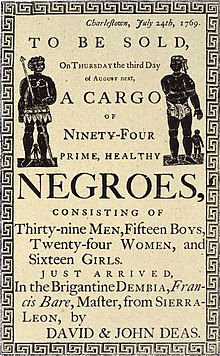
Reproduction of a handbill advertizement a slave sale, in Charleston, S Carolina, in 1769
Several lines of psychological enquiry relate to the concept of dehumanization. Infrahumanization suggests that individuals recall of and care for outgroup members as "less homo" and more like animals;[xiv] while Austrian ethnologist Irenäus Eibl-Eibesfeldt uses the term pseudo-speciation, a term that he borrowed from the psychoanalyst Erik Erikson, to imply that the dehumanized person or persons are regarded equally not members of the human species.[33] Specifically, individuals associate secondary emotions (which are seen as uniquely human) more than with the ingroup than with the outgroup. Primary emotions (those experienced past all sentient beings, whether human or other animals) are found to be more associated with the outgroup.[fourteen] Dehumanization is intrinsically connected with violence.[ citation needed ] Often, one cannot do serious injury to another without first dehumanizing him or her in one's mind (as a form of rationalization.)[ citation needed ] Military training is, among other things, systematic desensitization and dehumanization of the enemy, and servicemen and women may discover it psychologically necessary to refer to the enemy every bit an creature or other non-human beings. Lt. Col. Dave Grossman has shown that it would exist difficult without such desensitization, if non incommunicable, to kill another human, even in combat or under threat to their ain lives.[34]

According to Daniel Bar-Tal, delegitimization is the "categorization of groups into farthermost negative social categories which are excluded from human groups that are considered as acting inside the limits of adequate norms and values".[xv]
Moral exclusion occurs when outgroups are subject to a different prepare of moral values, rules, and fairness than are used in social relations with ingroup members.[16] When individuals dehumanize others, they no longer experience distress when they treat them poorly. Moral exclusion is used to explain farthermost behaviors like genocide, harsh clearing policies, and eugenics, but it tin can also happen on a more regular, everyday discriminatory level. In laboratory studies, people who are portrayed as lacking homo qualities are treated in a particularly harsh and trigger-happy style.[35] [36] [37] [ clarification needed ]
Dehumanized perception occurs when a subject experiences low frequencies of activation within their social knowledge neural network.[38] This includes areas of neural networking such as the superior temporal sulcus (STS) and the medial prefrontal cortex (mPFC).[39] A 2001 written report by psychologists Chris and Uta Frith suggests that the criticality of social interaction within a neural network has tendencies for subjects to dehumanize those seen as cloy-inducing, leading to social disengagement.[40] Tasks involving social cognition typically activate the neural network responsible for subjective projections of cloy-inducing perceptions and patterns of dehumanization. "Also manipulations of target persons, manipulations of social goals validate this prediction: Inferring preference, a mental-country inference, significantly increases mPFC and STS activity to these otherwise dehumanized targets."[ who said this? ] [41] A 2007 study past Harris, McClure, van den Bos, Cohen and Fiske suggests a bailiwick'south mental reliability towards dehumanizing social cognition due to decreased neural activity towards the projected target, replicating across stimuli and contexts.[ incomprehensible ] [42]
While social distance from the outgroup target is a necessary status for dehumanization, some research suggests that this alone is insufficient. Psychological research has identified loftier status, power, and social connection equally additional factors. Members of high-status groups more often acquaintance humanity with the ingroup than the outgroup, while members of low-status groups showroom no differences in associations with humanity. Thus, having a high condition makes one more likely to dehumanize others.[43] Low-status groups are more than associated with human nature traits (eastward.g., warmth, emotionalism) than uniquely human characteristics, implying that they are closer to animals than humans because these traits are typical of humans only tin exist seen in other species.[44] In addition, another line of work establish that individuals in a position of power were more than likely to objectify their subordinates, treating them as a means to one's cease rather than focusing on their essentially human being qualities.[45] Finally, social connection—thinking about a close other or being in the bodily presence of a close other—enables dehumanization by reducing the attribution of homo mental states, increasing support for treating targets like animals, and increasing willingness to endorse harsh interrogation tactics.[46] This is counterintuitive considering social connection has documented personal health and well-being benefits but appears to impair intergroup relations.
Neuroimaging studies have discovered that the medial prefrontal cortex—a brain region distinctively involved in attributing mental states to others—shows diminished activation to extremely dehumanized targets (i.due east., those rated, according to the stereotype content model, as depression-warmth and low-competence, such as drug addicts or homeless people).[47] [48]
Race and ethnicity [edit]

US government propaganda poster from WWII featuring a Japanese soldier depicted every bit a rat
Dehumanization often occurs as a result of intergroup conflict. Indigenous and racial others are often represented as animals in popular culture and scholarship. There is evidence that this representation persists in the American context with African Americans implicitly associated with apes. To the extent that an private has this dehumanizing implicit association, they are more likely to support violence against African Americans (east.g., jury decisions to execute defendants).[49] Historically, dehumanization is frequently continued to genocidal conflicts in that ideologies before and during the conflict depict victims equally subhuman (e.one thousand., rodents).[10] Immigrants may also be dehumanized in this way.[fifty]
In 1901, the six Australian colonies assented to federation, creating the modern nation state of Australia and its government. Department 51 (xxvi) excluded Aboriginals from the groups protected by special laws, and department 127 excluded Aboriginals from population counts. The Commonwealth Franchise Act 1902 categorically denied Aboriginals the right to vote. Ethnic Australians were not allowed the social security benefits (e.g., aged pensions and motherhood allowances) which were provided to others. Aboriginals in rural areas were discriminated confronting and controlled equally to where and how they could marry, work, live, and their movements.[51]
Language [edit]
Dehumanization and dehumanized perception tin can occur every bit a issue of the language used to describe groups of people. Words such every bit migrant, immigrant, and expatriate are assigned to foreigners based on their social status and wealth, rather than ability, achievements, or political alignment. Expatriate is a word to draw the privileged, often light-skinned people newly residing in an expanse and has connotations that suggest power, wealth, and trust. Meanwhile, the give-and-take immigrant is used to describe people coming to a new location to reside and infers a much less-desirable meaning.[52]
The give-and-take "immigrant" is sometimes paired with "illegal", which harbors a greatly derogatory connotation. Misuse of these terms—they are oft used inaccurately—to describe the other, can modify the perception of a group equally a whole in a negative mode. Ryan Eller, the executive manager of the immigrant advancement group, Ascertain American, expressed the problem this mode:[53]
It's non merely because information technology's derogatory, but because it'due south factually incorrect. Most of the time when we hear [illegal immigrant] used, most of the time, the shorter version 'illegals' is beingness used equally a substantive, which implies that a human being is perpetually illegal. In that location is no other nomenclature that I'one thousand enlightened of where the individual is being rendered as unlawful as opposed to those individuals' actions.
A series of language examinations establish a direct relation between homophobic epithets and social cognitive distancing towards a group of homosexuals, a form of dehumanization. These epithets (east.grand., faggot) were idea to function equally dehumanizing labels considering they tended to act as markers of deviance. Ane pair of studies establish that subjects were more likely to associate malignant linguistic communication with homosexuals, and that such language associations increased the physical distancing between the subject and the homosexual. This indicated that the malignant language could encourage dehumanization, cognitive and physical distancing in ways that other forms of malignant language do not.[54]
Human being races [edit]
In the US, African Americans were dehumanized past being classified equally non-human primates. The U.s. Constitution held that enslaved Africans would be counted equally three-fifths of a free person for purposes of federal representation and direct taxes.[ according to whom? ] A California police officer who was also involved in the Rodney King beating described a dispute between an American Black couple as "something right out of Gorillas in the Mist".[55] Franz Boas and Charles Darwin hypothesized that there might exist an evolutionary procedure among primates. Monkeys and apes were to the lowest degree evolved, then savage and deformed anthropoids, which referred to people of African beginnings, to Caucasians every bit most developed.[56]

Depiction of a slave auction in Ancient Rome. Anyone non a Roman citizen was subject field to enslavement and was considered private property.
Holding takeover [edit]

The Castilian Inquisition would seize the property of those accused of heresy and use the profits to fund the defendant's imprisonment, fifty-fifty before trial.
Property scholars define dehumanization equally "the failure to recognize an individual'due south or group'south humanity."[57] Dehumanization ofttimes occurs alongside property confiscation. When a property takeover is coupled with dehumanization, the consequence is a dignity taking.[57]
There are several examples of dignity takings involving dehumanization.
From its founding, the United States repeatedly engaged in nobility takings from Native American populations, taking indigenous land in an "undeniably horrific, trigger-happy, and tragic record" of genocide and ethnocide.[58] Equally recently as 2013, the deposition of a mountain sacred to the Hopi people—by spraying its superlative potwith artificial snow made from wastewater—constituted another dignity taking by the U.S. Wood Service.[58]
The Tulsa Race Massacre of 1921 besides constituted a dignity taking involving dehumanization.[59] White rioters dehumanized African Americans past attacking, annexation, and destroying homes and businesses in Greenwood, a predominantly Black neighborhood known as "Black Wall Street."[59]
During the Holocaust, mass genocide—a astringent class of dehumanization—accompanied the destruction and taking of Jewish property.[60] This constituted a dignity taking.[60]
Undocumented workers in the U.s. accept also been subject to dehumanizing dignity takings when employers treat them every bit machines instead of people to justify unsafe working conditions.[61] When harsh conditions lead to bodily injury or death, the property destroyed is the physical body.[61]
Media-driven dehumanization [edit]
The propaganda model of Edward S. Herman and Noam Chomsky argues that corporate media are able to carry out large-scale, successful dehumanization campaigns when they promote the goals (turn a profit-making) that the corporations are contractually obliged to maximize.[62] [63] Country media are also capable of carrying out dehumanization campaigns, whether in democracies or dictatorships, which are pervasive plenty that the population cannot avoid the dehumanizing memes.[62]
Non-state actors [edit]
Not-state actors—terrorists in detail—have besides resorted to dehumanization to further their crusade. The 1960s terrorist grouping Atmospheric condition Hole-and-corner had advocated violence against any potency figure and used the "police are pigs" meme to convince members that they were not harming human beings only merely killing wildlife. Likewise, rhetoric statements such as "terrorists are but scum", is an human action of dehumanization.[64]
In science, medicine, and engineering [edit]

Relatively recent history has seen the relationship between dehumanization and science event in unethical scientific research. The Tuskegee syphilis experiment and Nazi homo experimentation on Jewish people are ii such examples. In the former, African Americans with syphilis were recruited to participate in a written report about the course of the disease. Fifty-fifty when treatment and a cure were eventually developed, they were withheld from the African-American participants so that researchers could continue their study. Similarly, Nazi scientists conducted horrific experiments on Jewish people during the Holocaust. This was justified in the proper noun of enquiry and progress, which is indicative of the far-reaching effects that the culture of dehumanization had upon this social club. When this research came to light, efforts were made to protect future inquiry participants, and currently, institutional review boards be to safeguard individuals from being exploited by scientists.
In a medical context, some dehumanizing practices have get more acceptable. While the dissection of human cadavers was seen as dehumanizing in the Dark Ages (meet history of beefcake), the value of dissections equally a training aid is such that they are now more widely accepted. Dehumanization has been associated with mod medicine generally and has explicitly been suggested as a coping mechanism for doctors who work with patients at the end of life.[10] [65] Researchers accept identified half-dozen potential causes of dehumanization in medicine: deindividuating practices, dumb patient bureau, contrast (causes which do not facilitate the delivery of medical treatment), mechanization, empathy reduction, and moral disengagement (which could be argued to facilitate the delivery of medical treatment).[66]
In some United states of america states, controversial legislation requires that a woman view ultrasound images of her fetus before having an abortion. Critics of the law argue that merely seeing an image of the fetus humanizes it and biases women against abortion.[67] Similarly, a recent study showed that subtle humanization of medical patients appears to improve care for these patients. Radiologists evaluating X-rays reported more details to patients and expressed more empathy when a photo of the patient's face up accompanied the X-rays.[68] Information technology appears that the inclusion of the photos counteracts the dehumanization of the medical procedure.
Dehumanization has applications outside traditional social contexts. Anthropomorphism (i.e., perceiving mental and physical capacities that reflect humans in nonhuman entities) is the inverse of dehumanization..[69] Waytz, Epley, and Cacioppo suggest that the inverse of the factors that facilitate dehumanization (e.g., high status, power, and social connection) should promote anthropomorphism. That is, a low status, socially disconnected person without ability should be more likely to attribute human being qualities to pets or inanimate objects than a high-status, high-ability, socially connected person.
Researchers take establish that engaging in violent video game play diminishes perceptions of both one's own humanity and the humanity of the players who are targets of the game violence.[70] While the players are dehumanized, the video game characters are often anthropomorphized.
Dehumanization has occurred historically under the pretense of "progress in the proper noun of science". During the St. Louis World's fair in 1904, human zoos exhibited several natives from independent tribes worldwide, most notably a immature Congolese man, Ota Benga. Benga's imprisonment was put on display as a public service showcasing "a degraded and degenerate race". During this menstruation, religion was still the driving forcefulness backside many political and scientific activities. Because of this, eugenics was widely supported among the near notable US scientific communities, political figures, and industrial elites. After relocating to New York in 1906, public outcry led to the permanent ban and closure of homo zoos in the United States.[71]
In art [edit]
Francisco Goya, famed Spanish painter and printmaker of the romantic period, often depicted subjectivity involving the atrocities of war and brutal violence conveying the procedure of dehumanization. In the romantic catamenia of painting, martyrdom art was most often a means of deifying the oppressed and tormented, and it was common for Goya to describe evil personalities performing these unjust horrible acts. Simply information technology was revolutionary the way the painter broke this convention by dehumanizing these martyr figures. "...one would non know whom the painting depicts, so determinedly has Goya reduced his subjects from martyrs to meat".[72]
Run into as well [edit]
- American mutilation of Japanese war expressionless
- Depersonalization
- Human being zoo
- Infrahumanisation
- Life unworthy of life
- Moral disengagement
- Nonperson
- Perceived psychological contract violation
- Perceived organizational support
- Second-class denizen
- Social defeat
- Untermensch
References [edit]
- ^ Haslam, Nick (2006). "Dehumanization: An Integrative Review". Personality and Social Psychology Review. x (3): 252–264. doi:x.1207/s15327957pspr1003_4. PMID 16859440. S2CID 18142674. Archived from the original on 2020-09-10. Retrieved 2019-06-22 – via Lawrence Erlbaum Associates, Inc.
- ^ Haslam, Nick; Loughnan, Steve (three Jan 2014). "Dehumanization and Infrahumanization". Almanac Review of Psychology. 65 (i): 399–423. doi:10.1146/annurev-psych-010213-115045. PMID 23808915.
- ^ Spens, Christiana (2014-09-01). "The Theatre of Cruelty: Dehumanization, Objectification & Abu Ghraib". Contemporary Voices: St Andrews Journal of International Relations. five (iii). doi:10.15664/jtr.946. ISSN 2516-3159.
- ^ Netzer, Giora (2018). Families in the Intensive Care Unit: A Guide to Understanding, Engaging, and Supporting at the Bedside. Cham: Springer. p. 134. ISBN9783319943367.
- ^ Enge, Erik (2015). Dehumanization as the Cardinal Prerequisite for Slavery. Grin Verlag. p. 3. ISBN9783668027107.
- ^ Gordon, Gregory Southward. (2017). Atrocity Speech Law: Foundation, Fragmentation, Fruition. Oxford Academy Printing. p. 286. ISBN978-0-19-061270-2.
- ^ "Dehumanization is a mental loophole." Free Peer Support for Male Sexual Abuse Survivors. 2019-03-17. Retrieved 2021-03-25 .
- ^ Yancey, George (2014). Dehumanizing Christians: Cultural Competition in a Multicultural World. New Brunswick, NJ: Transaction Publishers. p. 36. ISBN9781412852678.
- ^ "StackPath" (PDF). www.corteidh.or.cr . Retrieved 2021-03-25 .
- ^ a b c Haslam, Nick (2006). "Dehumanization: An Integrative Review" (PDF). Personality and Social Psychology Review. 10 (3): 252–264. doi:x.1207/s15327957pspr1003_4. PMID 16859440. S2CID 18142674. Archived from the original (PDF) on 2013-06-26.
- ^ Andrighetto, Luca; Baldissarri, Cristina; Lattanzio, Sara; Loughnan, Steve; Volpato, Chiara (2014). "Homo-itarian aid? Two forms of dehumanization and willingness to help later on natural disasters". British Journal of Social Psychology. 53 (three): 573–584. doi:ten.1111/bjso.12066. hdl:10281/53044. ISSN 2044-8309. PMID 24588786.
- ^ Moller, A. C., & Deci, E. Fifty. (2010). "Interpersonal command, dehumanization, and violence: A self-determination theory perspective". Group Processes & Intergroup Relations, 13, 41-53. (open access) Archived 2013-06-22 at the Wayback Machine
- ^ Haslam, Nick; Kashima, Yoshihisa; Loughnan, Stephen; Shi, Junqi; Suitner, Caterina (2008). "Subhuman, Inhuman, and Superhuman: Contrasting Humans with Nonhumans in Three Cultures". Social Cognition. 26 (2): 248–258. doi:10.1521/soco.2008.26.2.248.
- ^ a b c Leyens, Jacques-Philippe; Paladino, Paola M.; Rodriguez-Torres, Ramon; Vaes, Jeroen; Demoulin, Stephanie; Rodriguez-Perez, Armando; Gaunt, Ruth (2000). "The Emotional Side of Prejudice: The Attribution of Secondary Emotions to Ingroups and Outgroups" (PDF). Personality and Social Psychology Review. 4 (2): 186–197. doi:10.1207/S15327957PSPR0402_06. S2CID 144981501. Archived from the original (PDF) on 2013-06-11.
- ^ a b Bar-Tal, D. (1989). "Delegitimization: The extreme case of stereotyping and prejudice". In D. Bar-Tal, C. Graumann, A. Kruglanski, & W. Stroebe (Eds.), Stereotyping and prejudice: Changing conceptions. New York, NY: Springer.
- ^ a b Opotow, Susan (1990). "Moral Exclusion and Injustice: An Introduction". Journal of Social Problems. 46 (1): 1–20. doi:10.1111/j.1540-4560.1990.tb00268.x.
- ^ Nussbaum, Thou. C. (1999). Sex and Social Justice. Oxford, England: Oxford Academy Press. ISBN 0195112105
- ^ Goof, Phillip; Eberhardt, Jennifer; Williams, Melissa; Jackson, Matthew (2008). "Not withal human: implicit knowledge, historical dehumanization, and contemporary consequences" (PDF). Journal of Personality and Social Psychology. 94 (two): 292–306. doi:10.1037/0022-3514.94.2.292. PMID 18211178. Archived (PDF) from the original on 17 October 2016. Retrieved vii May 2016.
- ^ Livingstone Smith, David (2011). Less Than Human: Why We Demean, Enslave, and Exterminate Others . St. Martin'southward Press. pp. 336. ISBN9780312532727.
- ^ Smith, David Livingstone; Department of Philosophy, Florida State University (2016). "Paradoxes of Dehumanization". Social Theory and Practice. 42 (2): 416–443. doi:10.5840/soctheorpract201642222. ISSN 0037-802X. Archived from the original on 2020-09-ten. Retrieved 2020-09-x .
- ^ Kelman, H. C. (1976). "Violence without restraint: Reflections on the dehumanization of victims and victimizers". pp. 282-314 in G. M. Kren & L. H. Rappoport (Eds.), Varieties of Psychohistory. New York: Springer. ISBN 0826119409
- ^ Fredrickson, Barbara 50.; Roberts, Tomi-Ann (1997). "Objectification Theory: Toward Understanding Women's Lived Experiences and Mental Health Risks". Psychology of Women Quarterly. 21 (ii): 173–206. doi:10.1111/j.1471-6402.1997.tb00108.x. S2CID 145272074. Archived from the original on 2020-09-10. Retrieved 2014-eleven-07 .
- ^ Gervais, Sarah J.; Vescio, Theresa Thousand.; Förster, Jens; Maass, Anne; Suitner, Caterina (2012). "Seeing women equally objects: The sexual body part recognition bias". European Journal of Social Psychology. 42 (vi): 743–753. doi:10.1002/ejsp.1890.
- ^ Rudman, L. A.; Mescher, K. (2012). "Of Animals and Objects: Men's Implicit Dehumanization of Women and Likelihood of Sexual Assailment" (PDF). Personality and Social Psychology Message. 38 (vi): 734–746. doi:10.1177/0146167212436401. PMID 22374225. S2CID 13701627. Archived (PDF) from the original on 2014-eleven-07. Retrieved 2014-11-07 .
- ^ Martha C. Nussbaum (four Feb 1999). "Objectification: Section - Seven Ways to Care for A Person as a Thing". Sex and Social Justice. Oxford University Printing. p. 218. ISBN978-0-19-535501-7.
- ^ "Plains Humanities: Wounded Knee Massacre". Retrieved Baronial nine, 2016.
- ^ "Facebook labels declaration of independence as 'hate oral communication'". The Guardian . Retrieved February 7, 2021.
- ^ "Fifty. Frank Baum's Editorials on the Sioux Nation". Archived from the original on December ix, 2007. Retrieved 2007-12-09 . Full text of both, with commentary by professor A. Waller Hastings
- ^ Rickert, Levi (January sixteen, 2017). "Dr. Martin Luther Male monarch Jr: Our Nation was Born in Genocide". Native News Online. Native News Online. Archived from the original on Nov 26, 2018. Retrieved Jan 9, 2021.
- ^ "Reflection today: "Our nation was born in genocide when information technology embraced the doctrin..." Yale Academy. Archived from the original on June 3, 2020. Retrieved June 3, 2020.
- ^ a b Bender, Albert (February xiii, 2014). "Dr. Male monarch spoke out confronting the genocide of Native Americans". People'southward World . Retrieved November 25, 2018.
- ^ Johansen, Bruce E. (2013), Encyclopedia of the American Indian Movement, ABC-CLIO, "Brando, Marlon" (pp. 60–63); "Littlefeather, Sacheen" (pp. 176–178), ISBN978-1-4408-0318-5
- ^ Eibl-Eibisfeldt, Irenäus (1979). The Biology of Peace and War: Men, Animals and Aggression. New York Viking Press.
- ^ Grossman, Dave Lt. Col. (1996). On Killing: The Psychological Price of Learning to Kill in State of war and Society. Dorsum Bay Books. ISBN978-0-316-33000-viii.
- ^ Bandura, Albert (2002). "Selective Moral Disengagement in the Exercise of Moral Bureau" (PDF). Journal of Moral Education. 31 (2): 101–119. CiteSeerX10.one.1.473.2026. doi:10.1080/0305724022014322. S2CID 146449693. Archived (PDF) from the original on 2014-12-20. Retrieved 2014-11-07 .
- ^ Bandura, Albert; Barbaranelli, Claudio; Caprara, Gian Vittorio; Pastorelli, Concetta (1996). "Mechanisms of moral disengagement in the exercise of moral agency" (PDF). Journal of Personality and Social Psychology. 71 (two): 364–374. CiteSeerX10.i.1.458.572. doi:10.1037/0022-3514.71.2.364. Archived (PDF) from the original on 2014-11-07. Retrieved 2014-11-07 .
- ^ Bandura, Albert; Underwood, Bill; Fromson, Michael Eastward (1975). "Disinhibition of aggression through diffusion of responsibility and dehumanization of victims" (PDF). Journal of Research in Personality. 9 (4): 253–269. doi:ten.1016/0092-6566(75)90001-X. Archived (PDF) from the original on 2014-11-07. Retrieved 2014-11-07 .
- ^ Amodio, David 1000.; Frith, Chris D. (2006-04-01). "Meeting of minds: the medial frontal cortex and social cognition". Nature Reviews. Neuroscience. vii (4): 268–277. doi:10.1038/nrn1884. ISSN 1471-003X. PMID 16552413. S2CID 7669363.
- ^ Harris, Lasana T.; Fiske, Susan T. (2006-10-01). "Dehumanizing the lowest of the low: neuroimaging responses to extreme out-groups". Psychological Science. 17 (x): 847–853. doi:10.1111/j.1467-9280.2006.01793.ten. ISSN 0956-7976. PMID 17100784. S2CID 8466947.
- ^ Frith, Chris D.; Frith, Uta (2007-08-21). "Social cognition in humans". Electric current Biology. 17 (16): R724–732. doi:10.1016/j.cub.2007.05.068. ISSN 0960-9822. PMID 17714666. S2CID 1145094.
- ^ Harris, Lasana T.; Fiske, Susan T. (2007-03-01). "Social groups that elicit disgust are differentially processed in mPFC". Social Cognitive and Affective Neuroscience. 2 (ane): 45–51. doi:10.1093/browse/nsl037. ISSN 1749-5024. PMC2555430. PMID 18985118.
- ^ Harris, Lasana T.; McClure, Samuel M.; van den Bos, Wouter; Cohen, Jonathan D.; Fiske, Susan T. (2007-12-01). "Regions of the MPFC differentially tuned to social and nonsocial melancholia evaluation". Cognitive, Affective, & Behavioral Neuroscience. vii (iv): 309–316. doi:10.3758/cabn.7.four.309. ISSN 1530-7026. PMID 18189004.
- ^ Capozza, D.; Andrighetto, L.; Di Bernardo, G. A.; Falvo, R. (2011). "Does status bear upon intergroup perceptions of humanity?". Group Processes & Intergroup Relations. 15 (3): 363–377. doi:10.1177/1368430211426733. S2CID 145639435.
- ^ Loughnan, S.; Haslam, N.; Kashima, Y. (2009). "Understanding the Relationship between Attribute-Based and Metaphor-Based Dehumanization". Group Processes & Intergroup Relations. 12 (6): 747–762. doi:ten.1177/1368430209347726. S2CID 144232224.
- ^ Gruenfeld, Deborah H.; Inesi, Thousand. Ena; Magee, Joe C.; Galinsky, Adam D. (2008). "Power and the objectification of social targets". Journal of Personality and Social Psychology. 95 (1): 111–127. doi:x.1037/0022-3514.95.1.111. PMID 18605855.
- ^ Waytz, Adam; Epley, Nicholas (2012). "Social connection enables dehumanization". Journal of Experimental Social Psychology. 48 (ane): seventy–76. doi:10.1016/j.jesp.2011.07.012.
- ^ Harris, L. T.; Fiske, S. T. (2006). "Dehumanizing the Lowest of the Low: Neuroimaging Responses to Extreme Out-Groups" (PDF). Psychological Scientific discipline. 17 (10): 847–853. doi:10.1111/j.1467-9280.2006.01793.x. PMID 17100784. S2CID 8466947. Archived from the original (PDF) on 2014-05-xiii.
- ^ Harris, 50. T.; Fiske, Southward. T. (2007). "Social groups that arm-twist disgust are differentially processed in mPFC". Social Cerebral and Affective Neuroscience. two (1): 45–51. doi:ten.1093/browse/nsl037. PMC2555430. PMID 18985118.
- ^ Goff, Phillip Atiba; Eberhardt, Jennifer 50.; Williams, Melissa J.; Jackson, Matthew Christian (2008). "Not yet human: Implicit knowledge, historical dehumanization, and contemporary consequences". Journal of Personality and Social Psychology. 94 (two): 292–306. doi:ten.1037/0022-3514.94.ii.292. PMID 18211178.
- ^ O'Brien, Gerald (2003). "Boxy Food, Conquering Hordes, and Waste Materials: Metaphors of Immigrants and the Early Immigration Restriction Fence in the U.s.a." (PDF). Metaphor and Symbol. 18 (1): 33–47. doi:10.1207/S15327868MS1801_3. S2CID 143579187. Archived (PDF) from the original on 2014-11-07. Retrieved 2014-11-07 .
- ^ "About the 1967 Referendum" (PDF). Victorian Curriculum and Assessment Dominance. 2012. Archived from the original (PDF) on 18 April 2016. Retrieved vii May 2016.
- ^ Koutonin, Mawuna Remarque (2015-03-thirteen). "Why are white people expats when the rest of us are immigrants?". The Guardian. Archived from the original on 2019-09-09. Retrieved 2015-12-08 .
- ^ Esther Yu Hsi Lee (thirteen August 2015). "The Dehumanizing History Of The Words We've Used To Describe Immigrants". ThinkProgress . Retrieved iii July 2021.
- ^ Fasoli, Fabio; Paladino, Maria Paola; Carnaghi, Andrea; Jetten, Jolanda; Bastian, Brock; Bain, Paul G. (2015-01-01). "Not "only words": Exposure to homophobic epithets leads to dehumanizing and concrete distancing from gay men" (PDF). European Journal of Social Psychology. 46 (2): 237–248. doi:10.1002/ejsp.2148. hdl:10071/12705. ISSN 1099-0992. Archived (PDF) from the original on 2020-05-09. Retrieved 2019-12-09 .
- ^ Ap (1991-06-12). "Gauge Says Remarks on 'Gorillas' May Be Cited in Trial on Beating". The New York Times. ISSN 0362-4331. Archived from the original on 2017-10-09. Retrieved 2020-08-24 .
- ^ Goof, Phillip; Eberhardt, Jennifer; Williams, Melissa; Jackson, Matthew (2008). "Not nonetheless man: Implicit knowledge, historical dehumanization, and contemporary consequences" (PDF). Journal of Personality and Social Psychology. 94 (two): 292–306. doi:10.1037/0022-3514.94.2.292. PMID 18211178. Archived (PDF) from the original on 17 October 2016. Retrieved 7 May 2016.
- ^ a b Atuahene, Bernadette (2016). "Dignity Takings and Dignity Restoration: Creating a New Theoretical Framework for Understanding Involuntary Property Loss and the Remedies Required". Police force & Social Inquiry. 41 (iv): 801. doi:10.1111/lsi.12249. ISSN 1747-4469. S2CID 151377162.
- ^ a b Richland, Justin B. (2016). "Dignity as (Cocky-)Conclusion: Hopi Sovereignty in the Face of U.s. Dispossessions". Law & Social Inquiry. 41 (four): 921. doi:10.1111/lsi.12191. ISSN 1747-4469. S2CID 148319987.
- ^ a b Brophy, Alfred L. (2016). "When More than than Holding Is Lost: The Dignity Losses and Restoration of the Tulsa Riot of 1921". Law & Social Inquiry. 41 (4): 824–832. doi:10.1111/lsi.12205. ISSN 0897-6546. S2CID 147798196.
- ^ a b Veraart, Wouter (2016-06-29). "2 Rounds of Postwar Restitution and Dignity Restoration in the Netherlands and in France". Law & Social Research. 41 (4): 956–972. doi:x.1111/lsi.12212. ISSN 1747-4469. S2CID 147735669.
- ^ a b Rathod, Jayesh; Nadas, Rachel (2017-01-01). "Damaged Bodies, Damaged Lives: Immigrant Worker Injuries equally Dignity Takings". Chicago-Kent Law Review. 92 (iii).
- ^ a b Herman, Edward South., and Noam Chomsky. (1988). Manufacturing Consent: the Political Economy of the Mass Media. New York: Pantheon. Page xli
- ^ Thomas Ferguson. (1987). Golden Rule: The Investment Theory of Party Contest and the Logic of Money-Driven Politics
- ^ Graham, Stephen (2006). "Cities and the 'War on Terror'". International Journal of Urban and Regional Research. 30 (2): 255–276. doi:ten.1111/j.1468-2427.2006.00665.x.
- ^ Schulman-Green, Dena (2003). "Coping mechanisms of physicians who routinely work with dying patients". OMEGA: Periodical of Decease and Dying. 47 (three): 253–264. doi:10.2190/950H-U076-T5JB-X6HN. S2CID 71233667.
- ^ Haque, O. S.; Waytz, A. (2012). "Dehumanization in Medicine: Causes, Solutions, and Functions". Perspectives on Psychological Science. 7 (2): 176–186. doi:10.1177/1745691611429706. PMID 26168442. S2CID 1670448.
- ^ Sanger, C (2008). "Seeing and assertive: Mandatory ultrasound and the path to a protected choice". UCLA Law Review. 56: 351–408.
- ^ Turner, Y., & Hadas-Halpern, I. (2008, December 3). "The furnishings of including a patient'due south photo to the radiographic examination" Archived 2014-11-07 at the Wayback Machine. Paper presented at Radiological Society of N America, Chicago, IL.
- ^ Waytz, A.; Epley, N.; Cacioppo, J. T. (2010). "Social Cognition Unbound: Insights Into Anthropomorphism and Dehumanization" (PDF). Electric current Directions in Psychological Science. 19 (i): 58–62. doi:10.1177/0963721409359302. PMC4020342. PMID 24839358. Archived (PDF) from the original on 2015-09-24. Retrieved 2014-11-07 .
- ^ Bastian, Brock; Jetten, Jolanda; Radke, Helena R.M. (2012). "Cyber-dehumanization: Vehement video game play diminishes our humanity". Journal of Experimental Social Psychology. 48 (two): 486–491. doi:10.1016/j.jesp.2011.10.009.
- ^ Newkirk, Pamela (2015-06-03). "The human being who was caged in a zoo | Pamela Newkirk". The Guardian. Archived from the original on 2015-12-08. Retrieved 2015-12-08 .
- ^ Anderson, Emma (2013). The Death and Afterlife of the Northward American Martyrs. The states: Harvard Academy Printing. p. 91. ISBN9780674726161.
External links [edit]
- https://web.annal.org/spider web/20100929000211/http://www.psychwiki.com/wiki/Dehumanization
Source: https://en.wikipedia.org/wiki/Dehumanization
Posted by: brownthendre.blogspot.com
0 Response to "What If Inanimate Objects And Animals Could Speak"
Post a Comment