

Is A Cilia Found In A Plant Or Animal Cell
This folio content
one. Cilium
2. Flagellum
three. Structure
iv. Motion
5. Germination
Thouicrotubules are cytoskeleton components with important functions in cell physiology. The microtubule scaffold of the cytoplasm is highly plastic thanks to the polymerization and depolymerization capacity of microtubules. Notwithstanding, non all cell microtubules are under this shrinking or growing stages. Cilia, flagella and centrioles/basal bodies are cellular structures containing very stable (number and length) and highly organized microtubules. In this page we are dealing with cilia and flagella.
i. Cilium
Cilia are thin and long prison cell protrusions of almost 0.25 µm in diameter and about 10 to 15 µm in length, which can be plant in brute cells and some unicellular eukaryotic species. They are usually tightly packed at the complimentary surface of epithelial cells (Figures ane an 2), such as the epithelium of the respiratory tracts, epithelium of reproductive ducts, gills of fish and bivalves, etcetera. Cilia are motile structures and their main function is to move the surrounding liquid, similar the mucus of the respiratory tract surface, h2o around gill epithelium, but also the oocyte in the female person Fallopian duct. Many unicellular organisms can move propelled by cilia, and others can use them for generating water swirl for catching nutrient. Embryo nodal cilia take been implicated in initiating the left–right axis during embryonic development of vertebrates. Cilia motion is like chirapsia, which impulses the liquid parallel to the cell surface.

Figure 1. Scanning electron microscopy images showing the key canal of a lamprey spinal cord. Many cilia tin be observed (at higher magnification in B) and small microvilli at the apical domain of ependimal cells.
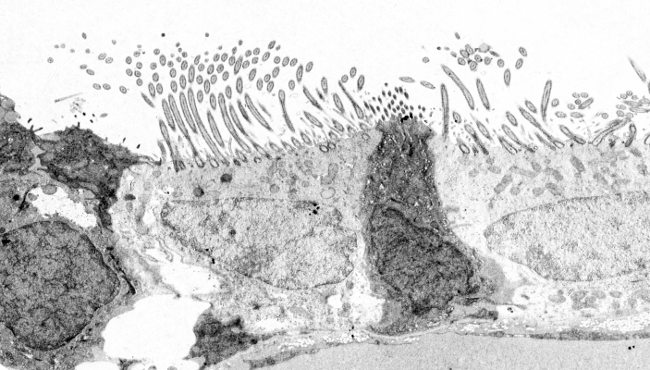
Effigy 2. Manual electron microscopy images of the respiratory epithelium. Cells with clear cytoplasm bear witness many cilia in their upmost surface.
There are cilia that cannot motion, and therefore they are not intended for liquid movement. These cilia are known equally primary cilia. Most cells study and then far (excepting reddish claret cells) bear primary cilia: oviduct cells, neurons, chondrocytes, ectoderm cells, mesenchymal cells, urinary epithelial cells, hepatocytes, and even cultured cells. Initially, primary cilia were though every bit not-functional cilia. However, many receptor types and ion channels were institute the ciliary membrane, so they were regarded as cell sensory structures. For example, olfactory receptors are constitute in cilia of their dendrites, and the external segments of rods and cones of the retin are really modified cilia. Some receptors are more highly packed in the ciliary membrane than in other plasma membrane domains. In improver, there is a wide variety of molecules in the interior of the cilia involved in signal transduction roles. The higher surface/volume ratio of a cilium makes intraciliary molecular responses more intense and efficient than if information technology were outside the cilium. Too chemic betoken, main cilia may observe fluid movement outside the cell and work as mechanoreceptors.
2. Flagellum
Flagella are similar to cilia, simply they are much longer, about 150 µm long, and slightly thicker. They are quite less numerous than cilia in cells. The principal function of flagella is to move the jail cell. The flagellum move is different from that of cilium considering the movement direction is perpendicular to the jail cell surface (non parallel), that is, the direction of the longitudinal axis of the flagellum. Flagella can be oft observed in motile cells like unicellular organisms and sperm.
iii. Structure
Cilia and flagella are complex structures containing more than 250 different proteins. Both share the same central microtubule organization and other associated proteins, birthday known every bit axoneme, and limited by plasma membrane (Effigy iii). Besides axoneme, there are many soluble molecules inside the cilia/flagella constituting the matrix. Axoneme is made upward of 9 pairs of microtubules around some other central pair of microtubules. This organization can be writen as (9 x 2) + 2. Primary cilia lack central pair of microtubules. Each microtubule of the fundamental pair is made up of xiii protofilaments, but microtubules of the peripheral pairs share some protofilaments between each other. Thus, a peripheral pair is formed past A and B microtubules. The A microtubule contains thirteen protofilaments and B microtubule contains 10 or eleven protofilaments, sharing 2 or three with A microtubule.

Figure 3. Main molecular components of cilia and flagella. In primary cilia, the central pair is absent.
The microtubule organization of the axoneme is the result of a scaffold of proteins. Twelve proteins take already been establish as constituents of the axoneme involved in maintaining microtubule system. The neighbour peripheral microtubule pairs are connected between each other by nexin. In each pair, the A microtubule is continued by poly peptide spokes to a central ring that contains the central pair or microtubules. Dinein is a motor poly peptide associated to the peripheral microtubules involved in the movement of cilia and flagella.

Figure 4. Ultrastructure of a cilium of an ependimal cell of the spinal string. (ix+2)x2 means 9 peripheral pairs and one fundamental pair of microtubules.
Thousandicrotubules are polymerized from basal bodies (Figures 3 and 4). Basal body is made up of nine triplet microtubules forming a cylinder (similar to centrioles). They lack a central pair of microtubules, then information technology is (9x3)+0. In each triplet, only one microtubule (A microtubule) has a complete set of protofilaments, whereas B and C microtubules share some of them between each other. From the basal body, A and B microtubules grow and class the peripheral microtubules of the axoneme. Just above the basal body, there is region of the cilia known every bit transition zone containing the nine peripheral pairs and no central pair. Immediately later the transition zone, at that place is the basal plate, from which the fundamental pair of microtubules is polymerized to complete the axoneme. All microtububles take the plus end toward the tip of the cilium/flagellum. The proximal terminate of the basal body (the inner one, or minus terminate of microtubules) is anchored to the cell cytoskeleton through long protein fibers called ciliary rootlets
Besides axoneme, cilia/flagella have other compartments. The membrane contains many receptors and channels for sensing the environment, especially in primary cilia. The fluid phase of the interior is called matrix, which helps with keeping organized the whole structure and is responsible for transducing the information gathered past membrane receptors. Other distinct areas are the basal body located at the base of operations and the apical part of the cilium/flagellum, which contains proteins that stabilize the plus ends of microbules.
iv. Movement
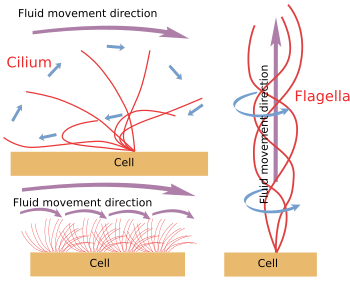
Figure 6. Models for cilium and flagella motion. They generate different fluid motility directions.
Westhen cilium/flagellum are mechanically discrete from the prison cell, they keep moving until the ATP shop is depleted. It means that the motility mechanism is intrinsic (Effigy 6). Actually, the movement is produced past sliding a peripheral pair of microtubules over the neighbor. Nexin and spoke proteins prevent the disorganization of the axoneme, merely permit these movements. Dinein is the motor protein responsible for the sliding movement. The energy is provided by ATP. Dineins are anchored with its globular part to the A microtubule of 1 peripheral pair and with its tail part to the B microtubule of the adjoining pair. The molecular mechanism is like to that of the cytosolic dineins, but instead of transporting a cargo, information technology is moving a microtubule. For an efficient movement, a coordination of the dineins of the axoneme is needed. Calcium waves in the interior of the cilia/flagella may coordinate dineins activation and alter the motility frequency when needed. It is of notice that not all dineins have to exist activated at the same time, just in synchrony.
5. Formation
Due westuring differentiation, cells produce all necessary cilia and flagella for their normal physiology. It means that all of them must be generated from scratch. Axoneme microtubules are nucleated from A and B microtubules of the basal bodies, so one basal torso per cilium/flagellum is needed. How multiple basal bodies are formed? In that location are at to the lowest degree three style of producing basal bodies: a) by using centrioles every bit templates for nucleating basal bodies; b) from baggy material known as deuterosome; c) in plants, there are distinct protein aggregates that can nucleate basal bodies.
Numerous homo pathologies are consequence of cilium/flagella flaws. They are known as ciliopathies, and include random laterality, wrong closure of the neural tube, polydactyly, cystic kidney, liver and pancreas pathologies, retina degeneration, obesity, and cognitive defects.
Bibliography
Marshall WF, Nonaka S. 2006. Cilia: tuning in to the cell'due south antenna. Current biological science. 16:R604-R614.
Satir P, Christensen ST. 2007. Overview of construction and function of mammalian cilia. Almanac review of phisiology. 69:377-400.
Source: https://mmegias.webs.uvigo.es/02-english/5-celulas/ampliaciones/7-cilio-flagelo.php
Posted by: brownthendre.blogspot.com
0 Response to "Is A Cilia Found In A Plant Or Animal Cell"
Post a Comment