

What Is An Ivc Filter
| Inferior vena cava filter | |
|---|---|
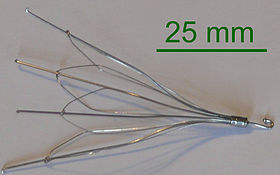 Junior vena cava filter - Gunther Tulip.[ane] | |
| Other names | IVC filter |
| Specialty | Cardiovascular |
An inferior vena cava filter is a type of vascular filter, a medical device that is implanted past vascular surgeons or interventional radiologists into the junior vena cava to prevent life-threatening pulmonary emboli (Foot).[2] Their effectiveness and safety profile is well established. In cases where patients are at high gamble of developing a clinically significant PE and cannot be sufficiently anticoagulated, placement of an IVC filter may exist recommended.[three]
To engagement, there has been only one randomized controlled trial completed on IVC filters. This study found that IVC filters reduced the incidence of PE but increased the incidence of deep vein thrombosis (DVT). All patients were on anticoagulation drugs during the study.[4] Results from the PREPIC report and other studies which have shown many long-term complications of IVC filters led to the introduction of retrievable IVC filters. The first retrievable IVC filters were approved past FDA in 2003 and 2004.[v]
In 2012, the American College of Chest Physicians recommended IVC filters for those with contraindications to anticoagulation who either have acute PE or acute proximal (above the knee) deep vein thrombosis (DVT).[half-dozen] [7] [ needs update ]
History [edit]

Image showing an junior vena cava filter in its position
The offset IVC filter was created past Kazi Mobin-Uddin, Physician who published his findings in 1969 in the New England Journal of Medicine.[8] [9] [x] [11] The Mobin-Uddin filter was later on replaced by the Greenfield filter adult past Lazar Greenfield which had a lower rate of filter related complications.[10]
Medical uses [edit]

Inferior vena cava filter as seen on plainly X ray of the abdomen
While the power to remember a filter does exist for many models, it cannot be guaranteed that all cases of filter placement volition allow for, or be indicated for retrieval. Thus, the requirements and indications for permanent placement of filters is used to decide on when to use both permanent and temporary IVC filters.[12]
Long-term risk factors must be considered besides, to include life expectancy of more 6 months following insertion, and the ability of the patient to comply with anticoagulation therapy.[three] The decision to use a filter that is temporary vs permanent basically is tied to the expected duration of time that protection is needed to prevent pulmonary emboli from passing to the heart and lungs. One such guideline is outlined below:[12]
- Contraindications to anticoagulation; e.chiliad. a patient with DVT or PE who has another condition that puts them at risk of bleeding, such as a recent bleed into the brain, or a patient about to undergo major surgery
- Curt-term run a risk of PE/Short-term contraindication of anticoagulation: Usually merits a retrievable filter
- Uncertain adventure of PE and/or lack of command for anticoagulation: Unremarkably results in permanent filters for long term management
- Long-term adventure of PE/recurrent PE/recurrent DVT: permanent filter
Indication categories [edit]
While many studies take been done on the efficacy of Vena Cava filters, there still have not been whatever major studies done on the bodily placement and removal of the filters regarding standard guidelines. Which is why the Society of Interventional Radiology created a multidisciplinary panel that adult the following guidelines to see if someone qualifies for implantation:[ commendation needed ]
Absolute indications [edit]
These are patients that should strongly consider having IVC filter placement, as they are at greatest hazard of pulmonary embolus.
- Proven VTE: Venous thromboembolism and contraindication or complication due to anticoagulation therapy
- Recurrent VTE: Despite adequate anticoagulation therapy
Relative indications [edit]
This is a maybe category; normally information technology represents patients who could do good from an IVC filter, but may be but fine without one equally well.[ citation needed ]
- Proven VTE: High run a risk of contraindication or complication to arise during anticoagulation therapy
- Big, free-floating proximal DVT's
- Poor Compliance: INR levels are not stable, not taking medicine as directed
- Thrombolysis: Iliocaval DVT's, which are emboli in the Illiac region
Prophylactic indications [edit]
These are normally very controversial reasons to exercise an IVC filter, and most radiologists and doctors more often than not will not recommend an IVC filter if other options are bachelor instead.
- No VTE: Anticoagulation therapy is not possible (high risk of haemorrhage)
- Transient gamble of VTE: Trauma, surgical procedures or medical weather
Other indications [edit]
- Bariatric patients: Undergoing surgery for weight control, simply if BMI greater than 55, previous history of DVT/PE, hypercoagulable state, chronic venous insufficiency, truncal obesity or contraindication to anticoagulation therapy.[13]
Indications for removing IVC filter [edit]
There is no electric current published information confirming the benefit of removing an IVC. Considering of this, the Society of Interventional Radiology created a multidisciplinary panel that adult the following guidelines to meet if someone qualifies for removal:[3]
- No need for permanent filter: Remove temporary
- Low risk of significant PE: Connected anticoagulation is working, remove temporary
- No expected near-term high-risk PE: Continuation of anticoagulation therapy, remove temporary
- Life expectancy of more than vi months: Remove temporary
- Ability to retrieve the filter: No complications, no tear probability, no trauma probability; if and then, remove temporary
Anticoagulation [edit]
In those with initial acute proximal DVT or astute PE who had IVC filters placed instead of anticoagulation, and who have their risk of haemorrhage resolve, the American College of Chest Physicians suggested, in 2012, that they receive a standard course of anticoagulation.[14] [xv] While IVC filters are associated with a long term adventure of DVT,[two] they are non, alone, reason enough to maintain extended anticoagulation.[16]
Side effects [edit]
The main role of a vena cava filter is to prevent decease from massive pulmonary emboli. Long-term clinical follow-up studies have shown that this is achieved in 96% of cases having a standard stainless-steel Greenfield filter.[17]
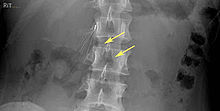
Abdominal radiograph shows that i of the legs (arrows) of the IVC filter is pointed away from the expected IVC lumen.
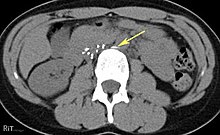
Axial CT image confirms that one of the legs (arrow) of the IVC filter has migrated out of the IVC wall into an adjacent tissue.
FDA communication [edit]
In Baronial, 2010, the FDA released an Initial Advice on the Hazard and Adverse events associated with Long Term utilise of an inferior vena cava filter.[eighteen] Over a menses of nearly 5 years, they identify 921 events. While not the majority of cases, that number still represents a statistical significance of the use of long-term IVCs.
Of these IVC filter side effects, 328 involved device migration, 146 involved embolizations after disengagement of device components, lxx involved perforation of the IVC, and 56 involved filter fracture. Much of the medical community believes that this large number of adverse events is related to the middle filter remaining in identify for longer than necessary.
Common issues relating to failure, to include death (the other 4% of cases) include:
- Device-associated morbidity
- Device migration
- Filter embolization
- Filter fracture
- Insertion-site thrombosis
- Perforation of the vena cava
- Recurrent DVT
- Recurrent PE
- Thrombotic complications
- Vena cava thrombosis
Less common adverse reactions [edit]
While these side effects are not common (less than x-xx% of patients), many exercise report issues stemming from the placement and complexity of the IVC while inside of the body.[xix]
- 9% (12 of 132 patients) delayed filter penetration of the IVC greater than 3 mm
- Parts of filter broke off in ii% (5 of 230 patients)
- Caval filter migrated to heart or pulmonary artery (4 patients)
Numerous small published articles and case studies report describe like issues to the above. Near notably:
- Filter fracture: Broken struts migrate to retroperitoneum, requiring exploration.[xx] Also struts can drift to the heart and tin cause pericardial effusion and tamponade.[21]
- Perforation into the duodenum: Resulting in severe diarrhea and weight loss.[22]
- Arterial hemorrhage: Requires surgery to avert death.[23]
- Misplaced Filter: Causes pericardiac tamponade requiring surgery under cardiopulmonary bypass.[24]
- Filter Migration to Correct Atrium: Resulting in astute myocardial infarction.[25]
- Filter Lodged in Middle: Causes life-threatening arrhythmia and ofttimes requires pacemakers to resolve condition.[26]
- Heart Migration: Requires surgery to remove IVC from centre.[27]
- Sudden Death: Caused past the filter migrating to an active region in the heart.[28]
- Migration of Filter to Chest: Requires surgery.[29]
- Perforation of filter strut into small-bowel: Requires surgery to repair perforation.[30]
Even though the cases in a higher place are the exception, and not the rule, nearly radiologists object to doing prophylactic filter insertions in patients who exercise not have thromboembolic diseases.[31] For the most role, whenever possible, interventional radiologists would rather start the patient on anticoagulants than employ an IVC, even if requested or referred via a doctor.[32]
MRI [edit]
While most IVC filters are made of non-ferromagnetic materials, in that location are a few types that are weakly ferromagnetic. Accordingly, IVC filters fall under the MRI Safe and MRI Conditional categories depending mostly on type of cloth used during construction. Rarely will one find an MRI Not Condom IVC filter, as virtually of the steel, and other ferromagnetic fabric devices accept been discontinued via the FDA.[ commendation needed ]
IVC filters are attached to the vena cava via hooks on their ends. Some are pinch springs, which shrink outward onto the side wall of the vena cava; however, they still have small hooks that retain their location. These hooks aid in the anchoring and healing procedure, as they let the tissues to 'ingrow' around them, securing the IVC in place. Information technology is unlikely, then, afterwards iv to 6 weeks of healing, that an MRI of 1.five tesla, up to 3 tesla, will cause any level of dislodging to occur to the IVC filter.[ citation needed ]
Studies of MR examination of both animals and humans, with implanted IVC filters, have not reported complications or symptomatic filter deportation.[33] [34] [35] [36] [37] [38]
Several creature studies accept fifty-fifty used "real-time" MR for the placement of IVC filters to check for rotation, sheering, and other artifacts.[39] [40]
Every bit part of the 'routing' survey for MRI studies, patients who have IVC filters will oft need verification from the doctor, or medical records, to state that the IVC is condom for the MRI. Nigh patients with weakly or non-safe ferromagnetic implants will be given a card, which they keep on their person at all time, that can help isolate if information technology is safe to do an MRI.
For patients who have been denied MRI scans for safe reasons, doctors usually recommend the CT browse with contrast as an alternative.
Labeling and recommendations [edit]
Most IVC filters that have been tested have been labeled as "MRi rubber"; the remainder of IVC filters that have been tested are "MR conditional." Patients who have been treated with nonferromagnetic IVC filters can undergo MR examination any time later on filter implantation. In patients who have been treated with a weakly ferromagnetic IVC filter (Gianturco bird nest IVC filter [Cook], stainless steel Greenfield vena cava filter [Boston Scientific]), it is advised that the patient wait at least six weeks before undergoing an MR examination (because these older devices initially may not be anchored as firmly in identify equally other devices discussed in the present context), unless there is a potent clinical indication to perform the MR examination sooner after implantation, and equally long as at that place is no reason to doubtable that the device is non positioned properly or that it is non firmly in place. Nigh studies of IVC filters have generally been conducted at i.5 tesla or less, although many IVC filters have now been evaluated at 3 tesla and accounted acceptable for MR test.[41] [42]
Placement [edit]
IVC filters are placed endovascularly, meaning that they are inserted via the blood vessels. Historically, IVC filters were placed surgically, but with mod filters that tin can exist compressed into much thinner catheters, access to the venous system tin be obtained via the femoral vein (the big vein in the groin), the internal jugular vein (the large vein in the neck) or the arm veins with one design. Option of route depends mainly on the number and location of whatsoever blood clot inside the venous system. To place the filter, a catheter is guided into the IVC using fluoroscopic guidance, then the filter is pushed through the catheter and deployed into the desired location, usually only below the junction of the IVC and the lowest renal vein.[43]
Review of prior cross-sectional imaging or a venogram of the IVC is performed before deploying the filter to assess for potential anatomic variations, thrombi within the IVC, or areas of stenoses, also as to estimate the bore of the IVC. Rarely, ultrasound-guided placement is preferred in the setting of dissimilarity allergy, chronic kidney disease, and when patient immobility is desired. The size of the IVC may touch on which filter is deployed, as some (such as the Birds Nest) are canonical to conform larger cavae. At that place are situations where the filter is placed above the renal veins (e.g. pregnant patients or women of childbearing historic period, renal or gonadal vein thromboses, etc.). Also, if there is duplication of the IVC, the filter is placed above the confluence of the two IVCs [44] or a filter tin can be placed within each IVC.[45]
Retrieval [edit]
The concept of a removable IVC filter was beginning conceived in 1967.[46] In 2003 and 2004 that the United States Nutrient and Drug Administration first approved retrieavable filters.[47] In 2005 that the Gild of Interventional Radiology (SIR) convened a multidisciplinary conference to address the clinical application of nonpermanent vena cava filters.[ commendation needed ]
Retrievable filters are fitted with a device (varying from model to model) that allows them to be hands snared and pulled back into a catheter and removed from the trunk, frequently through the jugular vein. Prior to 2004, filters that had been in the IVC for less than 3 weeks were considered suitable to endeavor retrieval, every bit filters that take been in identify longer might have been overgrown by cells from the IVC wall and in that location was an increased risk of IVC injury if the filter is dislodged. Newer designs, and developments in techniques hateful that some filters can at present be left in for prolonged periods and retrievals afterwards a year are now being reported.[48] This would include the ALN, Bard G2 and G2x, Option, Tulip and Celect filters.[ citation needed ]
It is important to note that the clinical examination prior to the removal of the filter is vital in understanding both the risk and pathophysiological effects removing the filter will accept on the patient. Doctors and medical professionals must consider several key factors (see Indications for removing IVC filters).[ citation needed ]
References [edit]
- ^ Gunther Tulip IVC Filter. Cook Medical. URL: http://www.cookmedical.com/di/di_front/images/dif_bu1.jpg. Accessed on: November 24, 2007.
- ^ a b Young T, Tang H, Hughes R (2010). Young T (ed.). "Vena caval filters for the prevention of pulmonary embolism" (PDF). Cochrane Database of Systematic Reviews (2): CD006212. doi:10.1002/14651858.CD006212.pub4. PMC7387443. PMID 20166079.
- ^ a b c Kaufman, JA; Kinney TB; Streiff MB; et al. (March 2006). "Guidelines for the employ of retrievable and convertible vena cava filters: written report from the Society of Interventional Radiology multidisciplinary consensus briefing". Periodical of Vascular and Interventional Radiology. 3. 17 (3): 449–459. doi:10.1097/01.rvi.0000203418-39769.0d. PMID 16567669.
- ^ PREPIC Written report, Group (19 July 2005). "Eight-year follow-upwardly of patients with permanent vena cava filters in the prevention of pulmonary embolism: the PREPIC (Prevention du Risque d'Embolie Pulmonaire par Interruption Cavern) randomized written report". Apportionment. 112 (three): 416–22. doi:ten.1161/circulationaha.104.512834. PMID 16009794.
- ^ Kaufman, JA; Kinney, TB; Streiff, MB; Sing, RF; Proctor, MC; Becker, D; Cipolle, M; Comerota, AJ; Millward, SF; Rogers, FB; Sacks, D; Venbrux, AC (2006). "Guidelines for the use of retrievable and convertible vena cava filters: written report from the Society of Interventional Radiology multidisciplinary consensus conference". Surgery for Obesity and Related Diseases. two (2): 200–12. doi:10.1016/j.soard.2006.03.009. PMID 16925346.
- ^ Guyatt et al. 2012, p. 21S: two.13.2.
- ^ Guyatt et al. 2012, p. 24S: 5.9.two.
- ^ Mobin-Uddin K, Callard GM, Bolooki H, Rubinson R, Michie D, Jude JR (1972). "Transvenous caval break with umbrella filter". New England Journal of Medicine. 286 (2): 55–8. doi:x.1056/NEJM197201132860202. PMID 5006878.
- ^ Cain, PG (1995). "Comment on "Treatment of venous disease — The innovators". Journal of Vascular Surgery. 22 (iii): 341–2. doi:10.1016/s0741-5214(95)70156-7. PMID 7674480.
- ^ a b Galanaud JP, Laroche JP, Righini 1000 (2013). "The history and historical treatments of deep vein thrombosis". Journal of Thrombosis and Haemostasis. 11 (3): 402–xi. doi:10.1111/jth.12127. PMID 23297815. S2CID 23288926.
- ^ Hussain, SA (1999). "Kazi Mobin-Uddin, 1930-1999". Journal of Vascular Surgery. 32 (2): 406–7. doi:10.1067/mva.2000.108645. PMID 10918004.
- ^ a b Kaufman, JA. "Guidelines for the use of retrievable vena cava filters". Affect Briefings. Retrieved 20 December 2010.
- ^ Baumann, DS. "IVC filter placement in bariatric patients". Endovsc Today. Retrieved 2012-10-11 .
- ^ Guyatt et al. 2012, p. 21S: 2.13.3.
- ^ Guyatt et al. 2012, p. 24S: five.nine.three.
- ^ Guyatt et al. 2012, p. 21S: two.13.
- ^ Greenfield, LJ; Peyton R; Crute S; Barnes R (1981). "Greenfield vena caval filter feel: late results in 156 patients". Archives of Surgery. 116 (xi): 1451–1456. doi:x.1001/archsurg.1981.01380230065010. PMID 7305658.
- ^ Food and Drug Administration. "Inferior Vena Cava (IVC) Filters: initial Advice: Risk of Adverse Events with Long Term Usage". United States Food and Drug Administration. Retrieved 2015-03-15 .
- ^ Ferris, EJ; McCowen TC; Carver DK; McFarland DR (1993). "Percutaneous inferior vena cava filters: follow-up of vii designs in 320 patients". Radiology. 188 (3): 851–856. doi:ten.1148/radiology.188.three.8351361. PMID 8351361.
- ^ Taheri, SA; Kulaylat MN; Johnson East; Hoover E (1992). "A complication of the Greenfield filter: fracture and distal migration of two struts, a case report". Journal of Vascular Surgery. 16 (1): 96–99. doi:10.1016/0741-5214(92)90424-7. PMID 1619731.
- ^ Kalavakunta, Jagadeesh Thou.; Thomas, Christopher Southward.; Gupta, Vishal (2009-11-01). "A needle through the eye: rare complication of junior vena caval filters". The Journal of Invasive Cardiology. 21 (11): E221–223. ISSN 1557-2501. PMID 19901424.
- ^ Appleberg, M; Crozier JA (1991). "Duodenal penetration by a Greenfield caval filter". ANZ Journal of Surgery. 61 (12): 957–960. doi:x.1111/j.1445-2197.1991.tb00017.ten. PMID 1755779.
- ^ Howerton, RM; Watkins Grand; Feldman L (1991). "Tardily arterial hemorrhage secondary to a Greenfield filter requiring operative intervention". Surgery. 109 (3 Pt i): 265–268. PMID 2000557.
- ^ Lahey, SJ; Meyer LP; Karchmer AW; et al. (1991). "Misplaced caval filter and subsequent pericardial tamponade". Annals of Thoracic Surgery. 51 (2): 299–300. doi:x.1016/0003-4975(91)90805-z. PMID 1989549.
- ^ Puram, B; Maley TJ; White NM; Rotman HH; Miller Yard (1990). "Acute myocardial infarction resulting from the migration of a Greenfield filter". Chest. 98 (6): 1510–1511. doi:ten.1378/chest.98.vi.1510. PMID 2245696.
- ^ Bach, JR; Zaneuski R; Lee H (1990). "Cardiac arrhythmias from a malpositioned Greenfield filter in a traumatic quadriplegic". American Journal of Concrete Medicine & Rehabilitation. 69 (5): 251–253. doi:10.1097/00002060-199010000-00005. PMID 2222985. S2CID 36313307.
- ^ Villard, J; Detry L; Clermont A; Pinet F (1987). "Eight cases of Greenfield filters in the correct heart cavities: their surgical treatment". Annals of Radiology. xxx: 102–104.
- ^ Poillaud, C; Paillard F; Biron Y; Gouffault J (1988). "Proximal migration of a caval filter: concerning of a case". Annales de Cardiology et d'Angéiologie. 37: 129–131.
- ^ LaPlante, JS; Contractor FM; Kiproff PM; Khoury MB (1993). "Migration of the Simon nitinol vena cava filter to the breast". American Journal of Roentgenology. 160 (2): 385–386. doi:x.2214/ajr.160.two.8424358. PMID 8424358.
- ^ Kupferschmid, JP; Dickson CS; Townsend RN; Diamond DL (1992). "Pocket-sized-bowel obstruction from an extruded Greenfield filter strut: an unusual tardily complication". Periodical of Vascular Surgery. 16 (1): 113–115. doi:10.1016/0741-5214(92)90427-a. PMID 1619711.
- ^ Emerson, RH Jr.; Cantankerous R; Head WC (1991). "Prophylactic and early on therapeutic use of the Greenfield filter in hip and knee joint arthroplasty". Journal of Arthroplasty. 6 (2): 129–135. doi:10.1016/s0883-5403(xi)80007-0. PMID 1875203.
- ^ Olin, JW; Young JR; Graor RA; Ruschhaupt WF; Beven EG; Bay JW (1987). "Treatment of deep-vein thrombosis and pulmonary emboli in patients with primary and metastatic brain tumors: anticoagulants or inferior vena cava filters?". Athenaeum of Internal Medicine. 147 (12): 2177–2179. doi:ten.1001/archinte.147.12.2177. PMID 3500686.
- ^ Watanabe AT, Teitelbaum GP, Gomes AS, Roehm JO Jr (1990). "MR imaging of the bird's nest filter". Radiology. 177 (two): 578–579. doi:10.1148/radiology.177.two.2217801. PMID 2217801.
- ^ Kiproff PM, Deeb ZL, Contractor FM, Khoury MB (1991). "Magnetic resonance characteristics of the LGM vena cava filter: technical note". Cardiovasc Intervent Radiol. 14 (4): 254–255. doi:ten.1007/bf02578474. PMID 1913742. S2CID 5815275.
- ^ Kim D, Edelman RR, Margolin CJ, Porter DH, McArdle CR, Schlam BW, Gianturco LE, Siegel JB, Simon Grand (1992). "The Simon nitinol filter: evaluation by MR and ultrasound". Angiology. 43 (vii): 541–548. doi:10.1177/000331979204300701. PMID 1626731. S2CID 33310735.
- ^ Grassi CJ, Matsumoto AH, Teitelbaum GP (1992). "Vena caval occlusion after Simon nitinol filter placement: identification with MR imaging in patients with malignancy". J Vasc Interv Radiol. iii (3): 535–539. doi:ten.1016/s1051-0443(92)72008-9. PMID 1515724.
- ^ Bartels LW, Bakker CJ, Viergever MA (2002). "Improved lumen visualization in metallic vascular implants by reducing RF artifacts". Magn Reson Med. 47 (1): 171–180. doi:10.1002/mrm.10004. PMID 11754456. S2CID 24558910.
- ^ Liebman CE, Messersmith RN, Levin DN, Lu CT (1988). "MR imaging of junior vena caval filters: safety and artifacts". American Journal of Roentgenology. 150 (5): 1174–1176. doi:10.2214/ajr.150.five.1174. PMID 3258722.
- ^ Bucker A, Neuerburg JM, Adam GB, Glowinski A, Schaeffter T, Rasche V, van Vaals JJ, Günther RW (2001). "Real-time MR guidance for inferior vena cava filter placement in an animal model". J Vasc Interv Radiol. 12 (vi): 753–756. doi:x.1016/s1051-0443(07)61448-1. PMID 11389228.
- ^ Frahm C, Gehl HB, Lorch H, Zwaan M, Drobnitzky M, Laub GA, Weiss Hd (1998). "MR-guided placement of a temporary vena cava filter: technique and feasibility". J Magn Reson Imaging. 8 (1): 105–109. doi:10.1002/jmri.1880080121. PMID 9500268. S2CID 30617216.
- ^ MRI safety. Institute for Magnetic Resonance Safety, Education, and Enquiry Web site. Available at: http://www.MRIsafety.com. Accessed June 19, 2006.
- ^ Shellock FG. Reference Manual for Magnetic Resonance Safety, Implants, and Devices: 2006 Edition. Los Angeles, Calif: Biomedical Enquiry Publishing Grouping; 2006.
- ^ Kinney, Thomas; Cameron, S; Sass, P; Zoller, M; Wigler, Grand (ane September 2006). "Junior Vena Cava Filters". Seminars in Interventional Radiology. 23 (3): 230–239. doi:ten.1055/s-2006-948760. PMC3036373. PMID 21326769.
- ^ Mano, Tatsumi T; Sakai H; et al. (2004). "A example of deep venous thrombosis with a double junior vena cava effectively treated by suprarenal filter implantation". Japanese Heart Journal. 45 (6): 1063–1069. doi:10.1536/jhj.45.1063. PMID 15655283.
- ^ Sartori, MT; Zampieri P; Andres AL; Prandoni P; Motta R; Miotto D (2006). "Double vena cava filter insertion in congenital duplicated junior vena cava: a case report and literature review". Haematologica. half-dozen. 91 (ECR30): ECR30. PMID 16785133.
- ^ Williams R, Schenk Westward (1970). "A removable intracaval filter for prevention of pulmonary embolism: early experience with the apply of the Eichelter catheter in patients". Surgery. 68 (6): 999–1008. PMID 5483252.
- ^ Kaufman J (2004). "Retrievable vena cava filters". Tech Vasc Interv Radiol. 7 (2): 96–104. doi:x.1053/j.tvir.2004.02.006. PMID 15252767.
- ^ McKenzie S, et al. (2010). "An Australian feel of retrievable inferior vena cava filters in patients with increased adventure of thromboembolic affliction". International Angiology. 29 (one): 53–57. PMID 20224533.
Cited literature [edit]
- Guyatt, GH; Akl, EA; Crowther, M; et al. (2012). "Executive Summary: antithrombotic therapy and prevention of thrombosis, 9th ed: American Higher of Breast Physicians prove-based clinical practice guidelines" (PDF). Chest. 141 (suppl two): 7S–47S. doi:10.1378/breast.1412S3. PMC3278060. PMID 22315257. Archived from the original (PDF) on 2012-09-07.
- Athanasoulis, Christopher A, MD (1993). "Complications of Vena Cava Filters". Radiology. 3. 188 (3): 614–615. doi:10.1148/radiology.188.3.8351319. PMID 8351319.
External links [edit]
- IVC filters - emedicine.com

What Is An Ivc Filter,
Source: https://en.wikipedia.org/wiki/Inferior_vena_cava_filter
Posted by: brownthendre.blogspot.com
0 Response to "What Is An Ivc Filter"
Post a Comment