

How Many Animals Enter Shelters Each Year
Pets by the numbers
Information and statistics on pet buying, customs cat and shelter populations in the The states

Agreement the Information
Obtaining authentic statistical information about pets in the Usa isn't easy. Nearly of the data is based on estimates derived from two periodic surveys, and the various survey takers practice not concur. Data reflecting shelter/rescue animal populations is spotty due to a lack of reporting requirements, which leaders in animal welfare are aiming to address with the Shelter Animals Count project.
In that location are two main sources of pet demographics in the U.s.a.: the biennial APPA National Pet Owners Survey by the American Pet Products Clan, and the U.S. Pet Ownership & Demographics Sourcebook past the American Veterinary Medical Association (AVMA) which is published every v years. These surveys provide information about trends in pet ownership and produce estimates of the total number of dogs and cats.
The post-obit is select data from the APPA and the AVMA. For additional information—including questions about how to interpret this data—please achieve out directly to the APPA and/or AVMA.
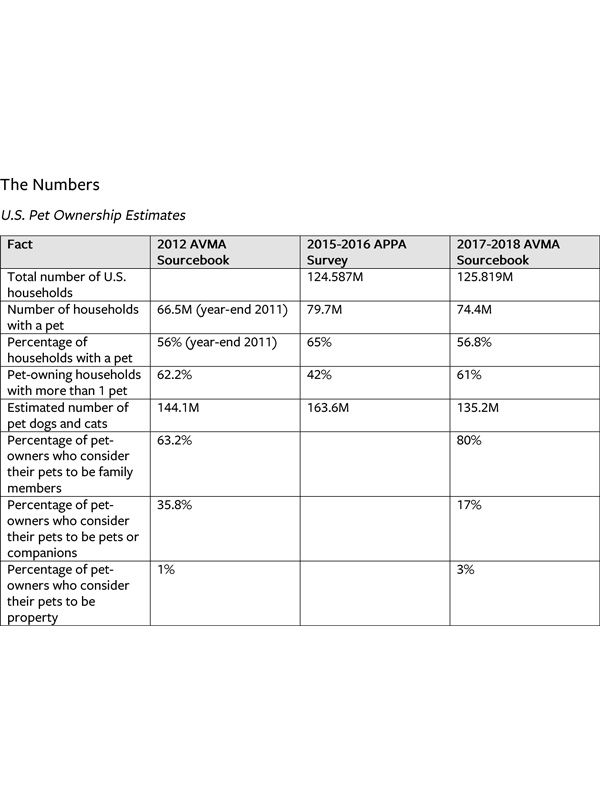
The Numbers
| Fact | 2017-2018 AVMA Sourcebook | 2021-2022 APPA Survey |
|---|---|---|
| Full number of U.Southward. households | 125.819M | 128.451M |
| Number of households with a pet | 74.4M (59%) | 90.5M* (70%) *In 1988, the APPA estimated 56% of U.S. households owned a pet. |
| Percentage of households that foster pets | 8% | |
| Per centum of pet owners who foster pets | 11% | |
| Pct of pet-owners who consider their pets to be family unit members | 80% | |
| Percentage of pet-owners who consider their pets to be pets or companions | 17% | |
| Percentage of pet-owners who consider their pets to be property | 3% |
| Fact | 2017-2018 AVMA Sourcebook | 2021-2022 APPA Survey |
|---|---|---|
| Households that ain at least one domestic dog | 48.3M (38%) | 69M (54%) |
| Percentage of U.Southward. population that owns a dog | vii% | |
| Canis familiaris-owning households with modest (< 25 lbs) dogs | 47% | |
| Dog-owning households with medium (25-xl lbs) dogs | 31% | |
| Dog-owning households with big (> twoscore lbs) dogs | 36% | |
| Percent of dog owners who consider their dogs to exist family members | 85% | |
| Percentage of dog owners who consider their dogs to be pets or companions | 14% | |
| Percentage of canis familiaris owners who consider their dogs to exist property | i% | |
| Boilerplate amount spent on veterinary visits per year, per household | $495 | $ane,344 |
| Percentage of owned dogs who are spayed or neutered | 69.1% | 78% |
| Pct of dogs who are "pure breed" | 48.7% | 56% |
| Percent of dogs who are mixed breed/"mutts" | 51.3% | 54% |
| Fact | 2017-2018 AVMA Sourcebook | 2021-2022 APPA Survey |
|---|---|---|
| Households that own at least i cat | 31.9M (25%) | 45.4M (35%) |
| Percentage of U.S. households that foster cats | 5% | |
| Percentage of new cat owners whose conclusion to learn a true cat was influenced past COVID-19 | forty% overall. 49% male, 33% female. 56% millennial, forty% Gen Z, 27% Baby Boomer and xix% Gen X. | |
| Percentage of cat owners who consider their cats to be family members | 76% | |
| Percentage of cat owners who consider their cats to be pets or companions | 20% | |
| Percentage of cat owners who consider their cats to be property | 3% | |
| Average corporeality spent on veterinary visits per yr, per household | $335 | $801 |
| Percentage of pet cats who are spayed or neutered | lxxx% | 85% |
| Percent of cats who are "pure breed" | xvi% | 31% |
| Pct of cats who are mixed brood/"mutts" | 84% | 75% |
| Fact | 2017-2018 AVMA Sourcebook | 2021-2022 APPA Survey |
|---|---|---|
| Dogs adopted from an creature shelter/humane gild or rescue group (may include adoptions via pet stores) | 28% | 40% |
| Cats adopted from an animal shelter or rescue group (may include adoptions via pet stores) | 31% | 43% |
| Dogs taken in as strays or defenseless exterior | five% | 4% |
| Cats taken in as strays or caught outside | 25% | 24% |
| Dogs acquired from friends or relatives | 26% | xviii% |
| Cats acquired from friends or relatives | 25% | 21% |
| Dogs purchased from a pet store | 6% | 9% |
| Cats purchased from a pet shop | 3% | 8% |
| Dogs purchased from a breeder | 22% | 21% |
| Cats purchased from a breeder | 3% | 4% |
| Dogs bred at home/from owned pet | 4% | |
| Cats bred at home/from owned pet | 7% | |
| Dogs received as a gift | iv% | |
| Cats received equally a souvenir | 3% |
Pet Buying Estimates from Underserved Communities
While the figures referenced previously tend to reflect mainstream America, the Pets for Life squad of the Humane Society of the Us has spent years working in, and collecting data from, our nation's near underserved communities which lack access to affordable and bachelor pet resource. Nosotros have found startling differences in pet buying. People living in underserved communities love their pets equally much as pet owners anywhere else in the nation. Withal, there is farthermost inequity in access to veterinarian intendance, spay/neuter providers and other services most Americans have for granted, and this difference is reflected in the information:
- Pets living in underserved communities in the U.S.: 22 million
- Pct of pets living in underserved communities who are non spayed or neutered: 88%
- Percentage of pets living in underserved communities who have never seen a veterinarian: 69%
Learn more nigh our Pets for Life program
Community Cat Estimates
Cats can be divided into three populations—those who are personal pets, those being cared for by shelters and rescues and those who alive their lives out in our communities. Community cats are friendly stray or abandoned cats as well equally feral (unsocialized) cats and cats who fall somewhere in between. These cats are unowned, merely may be provided with food, water and/or shelter by caring individuals. The HSUS advocates for a trap-neuter-render arroyo to humanely managing community cats.
- Estimated number of community cats in the U.South.: 30 to 40 million [i]
- Per centum of community cats who are spayed/neutered: Unknown (this will vary by community based on implementation of community cat management strategies)
- Average number of litters produced by an intact female community true cat: 1.four litters/year [two]
- Hateful number of kittens in each litter produced by intact community cats: 3 kittens/litter [2]
- Estimated survivorship of customs kittens, 0-6 months: 25% [2]
- Estimated annual survivorship of developed customs cats: lxx% [3]
- Percent of people who believe leaving a community cat outdoors is preferable to having him or her caught and euthanized: 81% [4]
- Percentage of people in the U.S. providing food for community cats: 10% of the general public and 17% of pet owners feed complimentary-roaming cats. [5, six]
- The Humane Society of the United states of america, Managing customs cats: A guide for municipal leaders. 2020. P. 3.
- Nutter, F.B., J.F. Levine, and M.G. Stoskopf, Reproductive capacity of free-roaming domestic cats and kitten survival rate. J Am Vet Med Assoc, 2004. 225(9): p. 1399-402.
- Gehrt, Due south.D., et al., Population ecology of free-roaming cats and interference contest by coyotes in urban parks. PLoS I, 2013. 8(nine): p. e75718.
- Chu, K. and W.Yard. Anderson, "U.S. Public Opinion on Humane Treatment of Stray Cats" Constabulary & Policy Brief 2007, Bethesda, Md: Alley Cat Allies.
- Levy, J.K. and P.C. Crawford, Humane strategies for decision-making feral cat populations. J Am Vet Med Assoc, 2004. 225(ix): p. 1354-lx.
- APPA, 2017-2018 American Pet Products Clan National Pet Owners Survey. 2018, Greenwich, CT: American Pet Products Association.
Larn how to help community cats
Shelter & Rescue Group Estimates
Authentic information from shelters and rescue groups is difficult to obtain because there is no central data reporting system for these institutions, and many nether-resourced shelters may not have the technology or ability to share their data nationally. The Humane Social club of the United States is working with a wide variety of stakeholders to change this through Shelter Animals Count, an initiative formed in 2011 to create and share a national database of sheltered animal statistics, providing facts and enabling insights that volition relieve lives and keep more pets with their families. In the meantime, here are the best estimates we've found:
| Pet | # Owned | # Entering Shelters Annually | % Euthanized in Shelters Annually | # Adopted from Shelters | # of Strays Entering Shelters Who Are Returned-To-Owner |
|---|---|---|---|---|---|
| Cats & Dogs | All-time Friends: 187M | ASPCA: 6.3M (down from 7.2M in 2011, with the biggest decline in dogs, from 3.9M to 3.1M) All-time Friends: 4.3M | ASPCA: 920,000 (15%)(downward from ii.6M in 2011) Best Friends: 347,000 (eight%) | ASPCA: four.1M Best Friends: iii.5M (83%) | ASPCA: 810,000 |
| Cats | Best Friends: 79M | ASPCA: iii.2M | ASPCA: 58% (530,000) | ASPCA: 2.1M | ASPCA: 100,000 |
| Dogs | All-time Friends: 108M | ASPCA: 3.1M | ASPCA: 42% (390,000) | ASPCA: i.2M | ASPCA: 710,000 |
*Sources:
ASPCA Pet Statistics
Best Friends Animal Shelter Statistics and Beast Welfare Statistics
- In some regions of the United states of america, 50-75% of the shelter population is cats, and cats and kittens are overwhelmingly more at hazard for euthanasia.
- The number of cats and dogs entering shelters annually is down significantly from twenty+ million in 1973. (Source: Dr. Andrew Rowan, January. 2019)
- The euthanasia of healthy, adoptable cats and dogs in U.S. shelters is downward to its lowest point in history. While hard to pinpoint an verbal effigy, best estimates are that fewer than 750,000 good for you and condom cats and dogs are euthanized annually. The remaining cats and dogs who are euthanized experience untreatable medical illnesses or are dangerous to identify in the community.Estimated amount spent by humane organizations annually: $three billion (about $ten per capita) (Source: Dr. Andrew Rowan, January. 2019)
- Estimated corporeality spent by creature command organizations annually: $800 million to $i billion (virtually $34 per capita) (Dr. Andrew Rowan, Jan. 2019)
- Estimated number of brick-and-mortar creature shelters in the Usa: 4,404 (Source: Best Friends Animal Society)
Certificate
Source: https://humanepro.org/page/pets-by-the-numbers
Posted by: brownthendre.blogspot.com
0 Response to "How Many Animals Enter Shelters Each Year"
Post a Comment