

The Arrival Of What Invention Spawned A Rebirth And Popularity Growth For Animation?
The Jazz Age
Jazz music exploded every bit popular amusement in the 1920s and brought African-American culture to the white middle class.
Learning Objectives
Analyze the development of jazz during the 1920s
Primal Takeaways
Key Points
- The Jazz Age was a mail-World War I move in the 1920s from which jazz music and dance emerged. Although the era ended with the first of the Great Depression in 1929, jazz has lived on in American popular culture.
- The birth of jazz music is credited to African Americans, but both black and white Americans akin are responsible for its immense rising in popularity.
- The ascension of jazz coincided with the rise of radio broadcast and recording applied science, which spawned the pop "potter palm" shows that included large-ring jazz performances.
- Female singers such as Bessie Smith emerged during this menstruum of postwar equality and open sexuality, paving the way for future female artists.
Key Terms
- Charleston: A 1920s-era dance popularized by African Americans and named for the city of Charleston, S Carolina.
- potter palm: A popular type of radio prove consisting of amateur concerts and large-band jazz performances broadcast from cities such equally New York and Chicago.
- flapper: A young woman whose unconventional clothing and progressive attitude personified the free spirit of the Roaring Twenties and the Jazz Historic period.
If freedom was the mindset of the Roaring Twenties, then jazz was the soundtrack. The Jazz Age was a cultural flow and movement that took identify in America during the 1920s from which both new styles of music and trip the light fantastic emerged. Largely credited to African Americans employing new musical techniques along with traditional African traditions, jazz before long expanded to America'southward white middle class.
Birth of Jazz
Following World War I, large numbers of jazz musicians migrated from New Orleans to major northern cities such as Chicago and New York, leading to a wider dispersal of jazz equally unlike styles developed in different cities. As the 1920s progressed, jazz rose in popularity and helped to generate a cultural shift. Because of its popularity in speakeasies, illegal nightclubs where alcohol was sold during Prohibition, and its proliferation due to the emergence of more avant-garde recording devices, jazz became very popular in a short amount of time, with stars including Knuckles Ellington, Cab Calloway, and Chick Webb. Several famous entertainment venues such as the Apollo Theater and the Cotton Social club came to epitomize the Jazz Historic period.

Cab Calloway: Cab Calloway became i of the almost popular musicians of the Jazz Age in the 1920s.
Growth of Jazz
African-American jazz was played more frequently on urban radio stations than on their suburban counterparts. Young people of the 1920s were influenced by jazz to rebel against the traditional civilization of previous generations, a rebellion that went paw-in-hand with fads such as the bold mode statements of the flappers and new radio concerts.
Dances such as the Charleston, developed by African Americans, instantly became popular among different demographics, including amidst young white people. With the introduction of large-scale radio broadcasts in 1922, Americans were able to experience different styles of music without physically visiting a jazz order. Through its broadcasts and concerts, the radio provided Americans with a trendy new avenue for exploring unfamiliar cultural experiences from the condolement of their living rooms. The virtually popular type of radio evidence was a "potter palm," an amateur concert and big-band jazz performance broadcast from New York and Chicago.

The King & Carter Jazzing Orchestra, 1921: During the Jazz Historic period, popular music included current dance songs, novelty songs, and show tunes.
Due to the racial prejudice prevalent at most radio stations, white American jazz artists received much more air time than black jazz artists such equally Louis Armstrong, Jelly Whorl Morton, and Joe "Male monarch" Oliver. Big-band jazz, similar that of James Reese in Europe and Fletcher Henderson in New York, was also popular on the radio and brought an African-American style and influence to a predominantly white cultural scene.
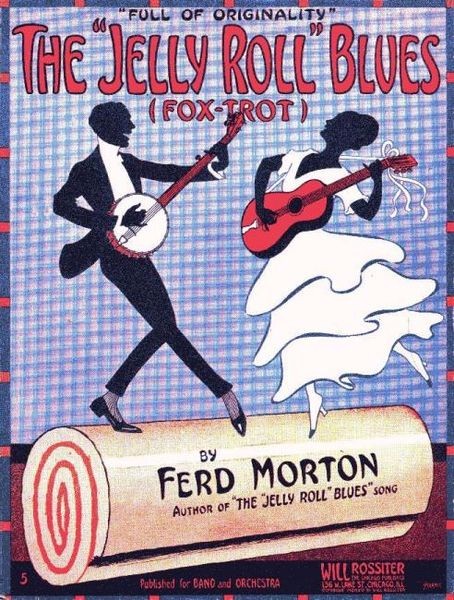
"The Jelly Roll Dejection": "The Jelly Curl Blues" was one of the first jazz songs to reach a widespread audition through radio play.
Flappers and Ladies of Jazz
The surfacing of flappers—women noted for their flamboyant manner of dress, progressive attitudes, and modernized morals—began to captivate society during the Jazz Age. This coincided with a period in American society during which many more opportunities became available for women, in their social lives and especially in the entertainment industry.
Several famous female musicians emerged during the 1920s, including Bessie Smith, who garnered attention non simply because she was a great singer, but besides because she was a blackness woman. It was not until the 1930s and 1940s, still, that female jazz and blues singers such every bit Smith, Ella Fitzgerald, and Billie Holiday were truly recognized and respected as successful artists throughout the music industry. Their persistence paved the way for many more female artists who came afterward.

Bessie Smith: The music of vocalist Bessie Smith was immensely pop during the Jazz Age, and she both influenced and paved the manner for generations of female artists.
Although the Jazz Age ended as the Great Depression struck and victimized America throughout the 1930s, jazz has lived on in American popular culture and remains a vibrant musical genre to this day.
Art Movements of the 1920s
Art Deco was a dominant blueprint way of the 1920s artistic era that also was influenced by the Dada, Expressionist, and Surrealist movements.
Learning Objectives
Describe popular fine art movements of the 1920s
Fundamental Takeaways
Key Points
- The 1920s was a period of meaning artistic growth that included definable schools of blueprint, architecture, and fine art that are still recognizable and influential today.
- Art Deco was the dominant manner of design and architecture in the 1920s. It originated and spread throughout Europe before making its presence felt in Due north American design.
- Expressionism and Surrealism were popular art movements in the 1920s that originated in Europe. Surrealism involved elements of surprise and unexpected juxtapositions, and both movements embraced a philosophy of nonconformity.
- Dada began in Zürich, Switzerland, and the manner incorporated nonsense, absurdity, and cubist elements.
Key Terms
- Dada: A cultural motility that began in Zürich, Switzerland, during Earth War I and peaked from 1916 to 1920. The movement primarily involved visual arts, literature (mainly poesy), theatre, and graphic blueprint, and was characterized by nihilism, deliberate irrationality, disillusionment, cynicism, risk, randomness, and the rejection of the prevailing standards in art.
- Expressionism and Surrealism: Avant-garde modernist cultural movements, originating in Europe in the early twentieth century.
- Art Deco: An eclectic artistic and design style that began in Paris in the 1920s and flourished internationally throughout the 1930s and into the World War II era.
The 1920s was a remarkable flow of creativity that brought along new, bold movements that changed the way the globe looked at itself, both externally and internally. In design and architecture, Art Deco originated in Europe and spread throughout the continent earlier its influence moved across the Atlantic to North America. In fine art, the movements known as Expressionism, Dada, and Surrealism all played major roles in reconfiguring the focus and perception non just of visual arts, but also of literature, drama, and pattern.
Art Deco
Art Deco was a dominant way in design and architecture of the 1920s. Originating in Europe, it spread throughout western Europe and North America in the mid-1920s and remained popular through the 1930s and early on 1940s, waning only afterward World State of war II. The proper name "Art Deco" is short for Arts Décoratifs, which came from the Exposition Internationale des Arts Décoratifs et Industriels Modernes (International Exposition of Modern Decorative and Industrial Arts) held in Paris in 1925. The first use of the term is attributed to architect Charles-Edouard Jeanneret-Gris, known as "Le Corbusier," who wrote a series of articles titled, "1925 Expo: Arts Déco," in his journal, L'Camaraderie Nouveau.
The eclectic style emerged from the years between World War I and Globe War II, oftentimes referred to equally the interwar menses, and combined traditional craft motifs with Machine Age imagery and materials and an comprehend of engineering science. Visually it is characterized by rich colors, lavish ornamentation, and geometric shapes. Artists employing the Art Deco fashion ofttimes drew inspiration from nature and initially favored curved lines, though rectilinear designs became increasingly pop.

The Chrysler Building: Art Deco architectural mode in the U.s.a. was epitomized past the Chrysler Building in New York City.
In the United states, New York City'southward Chrysler Edifice typified the Art Deco mode. Other American examples can be found in Chicago, Los Angeles, and San Francisco. The Hoover Dam, constructed between 1931 and 1936 on the border between Nevada and Arizona, includes Art Deco motifs throughout the structure including its water-intake towers and brass elevator doors.
Expressionism, Dada, and Surrealism
High german Expressionism began before Globe War I and exerted a stiff influence on artists who followed throughout the 1920s. Initially focused on poetry and painting, Expressionism typically presented the world from a solely subjective perspective, radically distorting it for an emotional effect that evokes moods or ideas rather than physical reality. Many artists, however, began to oppose Expressionist tendencies as the decade advanced.
The works of Vincent van Gogh and Edvard Munch'due south famous 1893 painting, The Scream, are thought to have influenced Expressionists, who counted among their numbers painters such as Wassily Kandinsky, Erich Heckel, and Franz Marc, as well equally dancer Mary Wigman.

The Scream: Edvard Munch'south 1893 painting, The Scream, influenced twentieth-century Expressionist artists.
Dada began in Zurich, Switzerland, during World State of war I and became an international phenomenon, although it was initially an informal movement intended to protestation the outbreak of World War I and the conservative, nationalist, and colonialist interests that Dadaists believed were root causes of the conflict. The move opposed cultural and intellectual conformity in fine art and in guild in full general, ordinarily displaying political affinities with the radical left. The reason and logic of the backer system had led to the war, Dadaists believed, and their rejection of that ideology led to an encompass of chaos and irrationality in their fine art. Machines, technology, and Cubist elements were features of their piece of work.
Dada artists met and formed groups of like-minded peers in Paris, Berlin, Cologne, and New York Metropolis who engaged in activities such every bit public gatherings, demonstrations, and publication of art and literary journals. Notable Dadaists included Richard Huelsenbeck, who established the Berlin group, and George Grosz, who called his piece of work a protest, "against this earth of mutual destruction."

Republican Automatons: The 1920 painting, Republican Automatons, by George Grosz was an example of Dadaist protestation art.
Arising from Dada activities during World State of war I and centered in Paris, Surrealism was a cultural motion that began in the early 1920s. Surrealism spread around the globe and impacted the visual arts, literature, theater, film, and music. The movement also informed political idea and practise, philosophy, and social theory.

The Elephant Celebes: Max Ernst'southward 1921 oil painting, The Elephant Celebes, was an example of European Surrealism, which profoundly influenced the artistic culture of the Usa.
Surrealist works featured elements of surprise, unexpected juxtapositions, and non sequitur. Many Surrealist artists and writers regarded their work as the material expression of the movement's philosophy. The motion'south leader, French anarchist and antifascist writer André Breton, emphasized that Surrealism was, higher up all, a revolutionary movement. In 1924 he published the Surrealist Manifesto, which called the movement "pure psychic automatism." Spanish painter Salvador Dali, best known for his 1931 piece of work, The Persistence of Memory, was one of the most famous practitioners of Surrealism.

The Persistence of Retentiveness: Salvador Dali'south 1931 painting, The Persistence of Memory, is one of the almost well-known examples of Surrealism.
Cinema
The 1920s are often referred to as the "Gilt Age of Hollywood," with "talkies" and the kickoff all-color features replacing silent films.
Learning Objectives
Describe cinema in the 1920s
Cardinal Takeaways
Key Points
- The 1920s in movie theater spawned the first characteristic with sound effects and music, Don Juan, and the offset picture with talking sequences, The Jazz Singer.
- Following the rise of talkies, large studios began acquiring movie-theater bondage across the country.
- Cartoon shorts were pop in movie theaters during this time; the late 1920s saw the emergence of Walt Disney.
- Most Hollywood pictures adhered closely to formulas—Western, slapstick comedy, musical, animated cartoon, biopic—and the aforementioned artistic teams oft worked on film, made by the same studio.
Fundamental Terms
- Talkies: The nickname given to movies with audio, which ended the era of silent films in Hollywood.
- Golden Historic period of Hollywood: A period during which Hollywood studios prolifically produced movies; it lasted from the end of the silent era in American picture palace in the late 1920s to the early 1960s.
- Don Juan: A 1926 Warner Bros. film, directed by Alan Crosland. It was the first feature-length film with synchronized Vitaphone sound furnishings and musical soundtrack, though it has no spoken dialogue.
At the get-go of the 1920s, films were silent and colorless. By the end of the decade, movie theatre had changed significantly with major leaps in engineering science that marked the "Gold Age of Hollywood" and ended the era of the silent film, which itself had ended the previous, widespread popularity of vaudeville theater. Box-office sales leapt to new heights as the studio system became the ascendant business model in movie making.
Color and Talkies
The first all-color feature, The Toll of the Bounding main, was released in 1922, with the next large bound coming in 1926 with the Warner Brothers Pictures (later shortened to Warner Bros.) release of Don Juan,the starting time feature with audio effects and music. In 1927, Warner Bros. followed that cinematic milestone with another in the form of The Jazz Singer,the first sound feature to include limited talking sequences. This release arguably launched what came to be known every bit the "Golden Age of Hollywood."

The Jazz Singer, 1927: Theatrical affiche for The Jazz Vocalizer, the first feature film to include talking sequences, which began the era of "talkies."
The public went wild for "talkies," and pic studios converted to sound almost overnight. In 1928, Warner Bros. releasedLights of New York , the beginning all-talking feature moving-picture show. In the same year, the first sound cartoon, "Dinner Time," was released. Warner Bros. ended the decade in 1929 by unveiling the showtime all-color, all-talking feature motion-picture show,On with the Show.
Animation
Cartoon shorts, using the moving sketch technique of animation, were popular in film theaters during this time. The late 1920s saw the emergence of Walt Disney and his eponymous studio. Disney's marquee character, Mickey Mouse, made his debut in "Steamboat Willie" on Nov 18, 1928, at the Colony Theater in New York Urban center. Mickey would go on to star in more than 120 cartoon shorts, too every bit in "The Mickey Mouse Gild" and other specials. This spring-started Walt Disney Studios and led to the creation of other characters going into the 1930s. Oswald, a grapheme created by Disney in 1927 earlier Mickey, was contracted by Universal Studios for distribution purposes and starred in a series of shorts between 1927 and 1928. He was the outset Disney grapheme to be merchandised.

Walt Disney: In 1928, Walt Disney gave the world "Steamboat Willie," aka Mickey Mouse, followed past numerous other cartoon characters who have go instantly recognizable.
The Studios and Stars
Most Hollywood pictures adhered closely to formulas—Western, slapstick comedy, musical, animated drawing, or biopic—and the same creative teams frequently worked on films made by the aforementioned studio. Cedric Gibbons and Herbert Stothart e'er worked on MGM films, Alfred Newman worked at 20th Century Fox for 20 years, Cecil B. DeMille's films were almost all fabricated at Paramount Pictures, and director Henry King'south films were by and large made for 20th Century Pull a fast one on.
Each studio had its own style and feature touches. Films were also easily recognizable equally the production of a specific studio largely based on the actors who appeared. MGM, for example, claimed it had contracted, "more stars than there are in heaven."
The menstruation saw the emergence of box-office stars, many of whom are still household names, such as Mae Murray, Ramón Novarro, Rudolph Valentino, Charlie Chaplin, Buster Keaton, Harold Lloyd, Warner Baxter, Clara Bow, Louise Brooks, Bebe Daniels, Billie Dove, Dorothy Mackaill, Mary Astor, Nancy Carroll, Janet Gaynor, Charles Farrell, William Haines, Conrad Nagel, John Gilbert, Greta Garbo, Dolores del Río, Norma Talmadge, Colleen Moore, Nita Naldi, John Barrymore, Norma Shearer, Joan Crawford, Mary Pickford, Douglas Fairbanks, Anna May Wong, and Al Jolson.
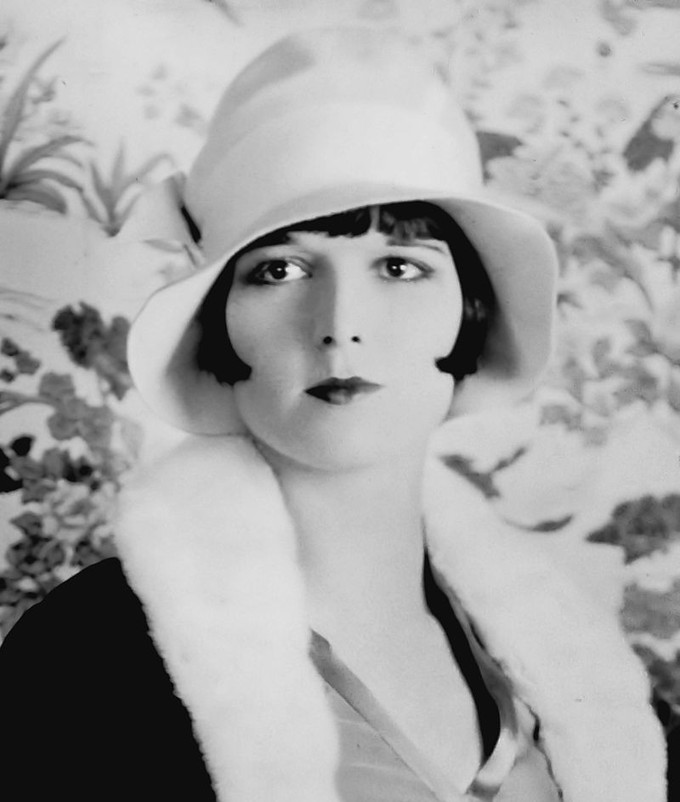
Louise Brooks: American extra Louise Brooks was one of the box-part stars who became famous in the 1920s at the commencement of the "Golden Age of Hollywood."
Each of these stars was contracted to work for a specific studio and distribution company, which was one aspect of the studio organization that became the dominant Hollywood concern model and continues today, albeit in a far less restrictive grade that does non tie actors to whatsoever specific company.
Theater Monopolies
After the release and huge success of The Jazz Vocaliser in 1927, Warner Bros. was able to acquire its own string of movie theaters, purchasing Stanley Theaters and First National Productions in 1928. MGM had owned the Loews string of theaters since its formation in 1924, while the Fob Film Corporation endemic the Fox Theatre chain. Paramount, which had already caused Balaban and Katz in 1926, purchased a number of theaters in the late 1920s, to the indicate of holding a monopoly on theaters in Detroit, Michigan. By the 1930s, all of America's theaters were owned by the "Big Five" studios: MGM, Paramount Pictures, RKO, Warner Bros., and 2oth Century Fox.

The Toll of the Bounding main, 1922: The Toll of the Bounding main, released in 1922, was the first colour feature made in Hollywood.
Flappers
Flappers were the personification of a new spirit in style, dance, and music in the 1920s.
Learning Objectives
Analyze the changing social norms characterized by the ascension of the flappers
Key Takeaways
Key Points
- Flappers were young women known for their styles of short hair, direct waists, and above-the-knee joint hemlines, too as for their general disdain for social and sexual norms.
- Flappers favored a immature and boyish style in women'southward fashion, which largely emerged as a result of French fashions, especially those pioneered past the French designer Coco Chanel. Short hair, flattened breasts, and straight waists were some mutual features of this wait.
- Dance clubs and contests became very popular in the 1920s. Classical pieces, operettas, and folk music were all transformed into popular trip the light fantastic toe melodies in gild to satisfy the public craze for dancing. The Cotton fiber Lodge and the Savoy Ballroom were pop venues.
- The well-nigh popular dances during the decade were the trick-trot, waltz, and American tango. From the early 1920s, a diversity of eccentric novelty dances were besides developed including the Breakaway, Charleston, and Lindy Hop.
Key Terms
- Musical: A stage performance, show, or motion picture that includes singing, dancing, and musical numbers performed past the cast.
- Jazz: A musical genre that originated in African-American communities during the tardily nineteenth and early twentieth centuries. It blended various styles including brass band, blues, and traditional African music to get a unique, international genre that continues to evolve today.
- Charleston: A popular dance during the 1920s, named for the oldest metropolis in South Carolina.
- Coco Chanel: (nineteen Baronial 1883–10 January 1971) A French designer of women's clothes and founder of the Chanel make. She is widely regarded as one of the greatest designers in the history of fashion.
The 1920s saw the rise of the flapper, a new breed of immature women who wore short skirts, bobbed their pilus, danced, and flouted social and sexual norms. Flappers were known for their style and the widespread popularization of new cultural trends that accompanied information technology. They personified the musical and dance movements emerging from the dance clubs playing jazz and new versions of old music, which became enormously popular in the 1920s and into the early on 1930s.
Flapper Style
Jazz and other new musical and dance forms exploded onto guild in the 1920s. This pop-culture movement was personified by the flappers, whose mode styles represented their gratis spirits and new social openness. This style largely emerged as a result of French fashions, especially those pioneered past the French designer Gabrielle Bonheur "Coco" Chanel. Chosen garçonne in French ("boy" with a feminine suffix), flapper style aimed to make girls appear young and boyish: brusk hair, flattened breasts, and straight waists were common features of this look. Although the styles typically associated now with flappers did not fully emerge until about 1926, there was an early on association in the public listen between unconventional appearance, outrageous behavior, and the discussion "flapper."

Coco Chanel, 1920: Gabrielle "Coco" Chanel was a French designer who was highly influential in the flapper fashion way of the 1920s.
The flapper look included short, disheveled hair in boyish styles such as the "bob cut," while finger waving was used equally a means of styling. The evolving flapper appearance required "heavy makeup" in comparison to what had previously been acceptable exterior of professional utilize in the theater. With the invention of the metal lipstick container and compact mirrors, bee stung lips and an emphatic mouth came into vogue. Huge, dark eyes heavily outlined in mascara and kohl-rimmed, were in way. Blush came into fashion when information technology ceased to be a messy application process.
Pale skin was originally considered to exist the most attractive, merely tanned peel became increasingly popular later Coco Chanel donned a tan after spending as well much time in the sunday on holiday. A tan suggested a life of leisure, without the onerous demand to work. In this way, women aspired to await fit, athletic, and salubrious. Jewelry usually consisted of Art Deco pieces, including beaded necklaces and brooches. Horn-rimmed spectacles were besides popular.
Despite whatsoever scandalous images flappers generated, their look became stylish in a toned-down class amidst respectable older women. Significantly, the flappers removed the corset from female way, raised skirt and gown hemlines, and popularized short hair for women. Flapper dresses were straight and loose, leaving the arms bare and dropping the waistline to the hips. Silk or rayon stockings were held upwards by garters. Skirts rose to just below the knee by 1927, allowing flashes of leg to exist seen when a girl danced or walked through a breeze. High heels betwixt two and three inches also became popular.
Flappers did away with corsets and pantaloons in favor of "step-in" panties and simple bust bodices to keep their chests in place while dancing. They as well wore new, softer and suppler corsets that reached to their hips, smoothing the whole frame, giving them a directly, upward-and-down appearance, equally opposed to the old corsets that slenderized the waist and absolute the hips and bust.
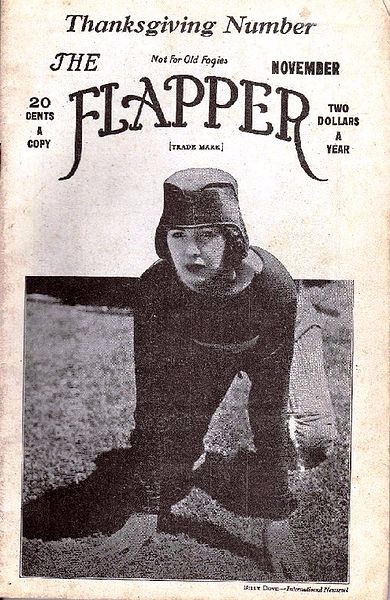
The Flapper Magazine: The encompass of the November 1922 effect of The Flapper magazine.
Dance Music, Clubs, and Contests
In the flapper menses, dance music took parts of various existing musical styles and created a new form. Classical pieces, operettas, and folk music were all transformed into popular dance melodies in society to satiate the public craze for dancing. For example, many of the songs from the 1929 Technicolor musical operetta, The Rogue Song, starring the Metropolitan Opera star Lawrence Tibbett, were rearranged and released as dance music and became popular club hits in 1929.
The advent of "talkies," motility pictures with synchronized audio, made musicals all the rage. Hollywood flick studios flooded the box office with improvident and lavish musical films, many of which were filmed in early Technicolor, a process that created color motion pictures rather than the starker blackness-and-white films. One of the about pop of these musicals, Aureate Diggers of Broadway, became the highest-grossing film of the decade in 1929.

Gilt Diggers of Broadway: The 1929 musical, Gilt Diggers of Broadway, became the highest-grossing film of the decade.
The Harlem neighborhood of New York City played a key function in the evolution of dance styles past serving as the location of several popular entertainment venues where people from all walks of life, races, and classes came together. The Cotton wool Club featured blackness performers and catered to a white clientele, while the Savoy Ballroom catered to a by and large black clientele.
Dance Styles
Dance clubs across the United States sponsored contests in which dancers invented and competed with new moves and professionals began to hone their skills in tap dance and other electric current moves. The most pop dances throughout the decade were the fox-trot, waltz, and American tango. Large numbers of recordings labeled under these styles gave rise to a generation of famous recording and radio artists.
From the early 1920s, however, the dance scene produced a variety of eccentric trends. The first of these were the Breakaway and the Charleston, which were both based on African-American musical styles and beats, including the widely pop dejection. The Charleston'due south popularity exploded after its characteristic in ii 1922 Broadway shows. A cursory Black Bottom dance craze, originating from the Apollo Theater, swept dance halls from 1926 to 1927, replacing the Charleston in popularity. By 1927, the Lindy Hop, based on the Breakaway and the Charleston and integrating elements of tap, became the dominant social trip the light fantastic and was the forebear of Swing dancing.

Josephine Baker does the Charleston: Celebrated vocalizer Josephine Baker dances the Charleston, 1 of the novelty dances that swept pop civilisation in the 1920s.
The Eugenics Movement
Eugenics, a prejudicial pseudoscience with roots in the tardily nineteenth and early twentieth centuries, gained popularity and impacted American land and federal laws in the 1920s.
Learning Objectives
Describe the goals and consequences of the eugenics move
Primal Takeaways
Fundamental Points
- The eugenics movement, which had its roots in European pseudoscience, played a major role in debates on U.S. immigration policy, particularly with the passage of the Immigration Act of 1924. Many believed immigrants were inferior and should be prevented from marrying and breeding.
- State laws were written in the late nineteenth and early twentieth centuries to prohibit union and force sterilization of the mentally ill in lodge to prevent the "passing on" of mental illness to the next generation.
- Both class and race factored in to eugenic definitions of "fit" and "unfit." By using intelligence testing, American eugenicists asserted that social mobility was indicative of i's genetic fitness.
- American eugenicists provided the so-called scientific proof used to justify racial oppression in the United states and Europe. Nazi administrators on trial for war crimes in Nuremberg after World War Two justified more than 450,000 mass sterilizations past citing American eugenics programs every bit their inspiration.
Fundamental Terms
- Charles B. Davenport: (1866–1944) A prominent American eugenicist and biologist. He was one of the leaders of the American eugenics movement, which was straight involved in the sterilization of effectually 60,000 "unfit" Americans and strongly influenced the Holocaust in Europe.
- eugenics: A social philosophy that advocates the improvement of human hereditary qualities through selective breeding.
- Francis Galton: (1822–1911) A British sociologist and anthropologist who coined the term "eugenics" and promoted the idea of the survival of the fittest in humans through selective breeding.
Eugenics was a field sociological and anthropological study that became popular in the late nineteenth and early twentieth centuries as a method of preserving and improving the population through cultivation of dominant factor groups. Rather than considered scientific genetics, nonetheless, eugenics is at present mostly associated with racist and nativist elements who desired then-chosen "scientific" bear witness for prejudicial behavior and regime policies. The eugenics motion in the United States was used to justify laws enabling forced sterilizations of the mentally ill and prohibiting marriages and child bearing past immigrants, while in Europe, eugenics theories were used past the Nazi regime in Germany to justify thousands of sterilizations and, subsequently, widespread murder.
Origins and Proliferation
In its time, eugenics was touted every bit scientific and progressive, the natural application of knowledge about convenance to the loonshit of human life. Researchers interested in familial mental disorders conducted studies to document the heritability of illnesses such as schizophrenia, bipolar disorder, and low. Rather than true science, though, eugenics was but an ill-considered social philosophy aimed at improving the quality of the human population by increasing reproduction betwixt those with genes considered desirable—Nordic, Germanic, and Anglo-Saxon peoples—and limiting procreation by those whose genetic stock was seen as less favorable or unlikely to improve the human factor pool. The method considered most viable in attaining this goal was the prevention of marriage and breeding amidst targeted groups and individuals, merely over fourth dimension, the far more farthermost action of sterilization became adequate.
While these ideas existed for centuries, the mod eugenics move tin can be traced to the United kingdom in the late nineteenth and early on twentieth centuries. The theory of evolution made famous by Charles Darwin was used by English sociologist and anthropologist Francis Galton, a one-half cousin of Darwin, to promote the idea of a human survival of the fittest that could exist enacted through selective breeding. He coined the term "eugenics" in 1883, and in 1909, wrote the foreword to the outset volume of the Eugenics Review,the periodical of the Eugenics Education Society, which named him as its honorary president.

Francis Galton: A one-half cousin of Charles Darwin, Francis Galton founded field of eugenics and promoted the improvement of the human genetic pool through selective breeding.
Legitimizing and Legalizing
Eugenicists and supporters began organizing and property formal discussions and conferences and publishing papers that proliferated through Europe and America. Three International Eugenics Congresses were held between 1912 and 1932, the first taking place in London. Leonard Darwin, son of Charles, presided over the meeting of virtually 400 delegates from numerous countries—including British luminaries such as the Master Justice Lord Balfour, and the First Lord of the Admiralty, Winston Churchill. The meeting served as an indication of the growing popularity of the eugenics movement.

Second International Eugenics Congress logo, 1921: Eugenics was a pop pseudoscience in the early on decades of the twentieth century and was promoted through iii International Eugenics Congresses between 1912 and 1932.
The American eugenics movement was rooted in the biological determinist ideas of Galton and included those who believed in the genetic superiority of specific Caucasian groups, supported strict immigration and anti-miscegenation laws, and supported the forcible sterilization of the poor, disabled, and "immoral."
Both class and race factored into eugenic definitions of "fit" and "unfit." Using intelligence testing, American eugenicists asserted that social mobility was indicative of one's genetic fettle. This reaffirmed the existing class and racial hierarchies and explained why the upper to middle class was predominately white, with middle to upper form status being a marker of "superior strains." Eugenicists believed poverty to be a characteristic of genetic inferiority, which meant that that those accounted "unfit" were predominately of the lower classes. Because poverty was associated with prostitution and "mental idiocy," women of the lower classes were the kickoff to be deemed "unfit" and "promiscuous." These women, who were primarily immigrants or women of color, were discouraged from bearing children, and were encouraged to use birth command.
American eugenics inquiry was funded past distinguished philanthropists and carried out at prestigious
universities, trickling down to classrooms where information technology was presented as a serious science. In 1906, J.H. Kellogg provided funding to aid institute the Race Betterment Foundation in Boxing Creek, Michigan. The Eugenics Tape Office (ERO) was founded in Common cold Spring Harbor, New York, in 1911 by the renowned biologist Charles B. Davenport, using money from both the Harriman railroad fortune and the Carnegie Institution.

Charles Benedict Davenport: American biologist Charles B. Davenport founded the Eugenics Record Office in 1911.
Laws were written in the late nineteenth and early twentieth centuries in America to prohibit wedlock and to force sterilization of the mentally sick in club to forbid the "passing on" of mental affliction to the next generation. The get-go land to introduce a compulsory sterilization bill was Michigan in 1897, simply the proposed police failed to garner plenty votes past legislators to exist adopted. 8 years later, Pennsylvania's state legislators passed a sterilization pecker that was vetoed by the governor. Indiana became the offset state to enact sterilization legislation in 1907, followed closely by Washington and California in 1909.
Consequences
Men and women were compulsorily sterilized for different reasons. Men were sterilized to treat their aggression and to eliminate their criminal behavior, while women were sterilized to control the results of their sexuality. Considering women bore children, eugenicists held women more accountable than men for the reproduction of the less "desirable" members of order. Eugenicists, therefore, targeted mostly women in their efforts to regulate the nativity rate, to "protect" white racial health, and to weed out the
"defectives" of club.
Sterilization rates across the country were relatively depression, California being the exception, until the 1927 Supreme Court case Buck v. Bong that legitimized the forced sterilization of patients at a Virginia home for the mentally retarded. These statutes were non abolished until the mid-twentieth century, with approximately lx,000 Americans legally sterilized.
Prior to the sterilization ruling in the Supreme Court, eugenicists had already played an important office in regime policy by serving equally skillful advisers on the threat of "inferior stock" from eastern and southern Europe during the Congressional debate over immigration in the early 1920s. This led to passage of the federal Immigration Act of 1924, which reduced the number of immigrants from abroad to xv percent from previous years.

Harry H. Laughlin: Harry H. Laughlin served as director of the Eugenics Record Role in Cold Bound Harbor, New York.
There are as well straight links betwixt progressive American eugenicists such as Harry H. Laughlin and racial oppression in Europe. Laughlin wrote the Virginia model statute that was the basis for the Nazi Ernst Rudin's Law for the Prevention of Hereditarily Diseased Offspring. Before the realization of decease camps in Globe War II, the idea that eugenics would lead to genocide was non taken seriously by the boilerplate American. When Nazi administrators went on trial for state of war crimes in Nuremberg later the war, however, they justified more than than 450,000 mass sterilizations in less than a decade past citing U.S. eugenics programs and policies as their inspiration. These sterilizations were the precursor to the Holocaust, the Nazi attempt at genocide against Jews and other ethnic groups they accounted unfavorable to the homo cistron pool.
The Southern Renaissance
The Southern Renaissance literary movement of the 1920s and 1930s broke from the romantic view of the Confederacy.
Learning Objectives
Describe the Southern Renaissance
Key Takeaways
Key Points
- Authors of the Southern Renaissance addressed iii major themes: the brunt of history related to slavery and loss, conservative Southern culture, and the region'southward clan with racism and slavery.
- The formation of the Fugitives, a grouping of poets and critics based in Nashville following Globe War I, is oftentimes referred to every bit the beginning of the Southern Renaissance. William Faulkner is regarded every bit the Southern Renaissance'southward most influential and famous writer.
- Opposition to industrialization in the South following Globe War I was a pop theme amid Southern Renaissance writers, who became known every bit "Southern Agrarians."
- African-American writers from the South, such as Richard Wright, were not considered function of the Southern Renaissance movement, which consisted exclusively of white authors.
Key Terms
- The Fugitives: A group of poets and literary scholars who came together at Vanderbilt Academy in Nashville, Tennessee, United States, around 1920.
- William Faulkner: (1897–1962) An American writer and Nobel laureate from Oxford,
Mississippi. He is best known for his 1929 novel, The Sound and the Fury. - H.Fifty. Mencken: (1880–1956) A journalist, satirist, cultural critic, and scholar. Known as the "Sage of Baltimore," he is regarded as ane of the nearly influential American writers and prose stylists of the first half of the twentieth century.
The Southern Renaissance was a motion that reinvigorated American Southern literature in the 1920s and 1930s. The writers of the movement bankrupt from mutual Southern cultural literary themes, notably the regrettable fall of the Confederacy, to address more personal and modernized viewpoints including opposition to industrialization and the Due south's abiding racism. The Southern Renaissance included famed writers such as William Faulkner, Tennessee Williams, and Robert Penn Warren. Perhaps ironically, however, this movement that explored racial questions and themes seemed to exclude African-American writers of the fourth dimension.
Origins and Themes
In the 1920s, the satirist H.50. Mencken led the attack on the genteel tradition in American literature, ridiculing the provincialism of American intellectual life. In his 1920 essay, "The Sahara of the Bozart," a pun on a Southern pronunciation of "Beaux Arts," he singled out the Due south as the most provincial and intellectually barren region of the United States, claiming that since the Civil War, intellectual and cultural life there had gone into terminal reject. This created a storm of protest from within bourgeois circles in the Due south. Many emerging Southern writers, still, already highly critical of contemporary life in the South, were emboldened by Mencken's essay. In response to the attacks of Mencken and his imitators, Southern writers were provoked to reassert Southern uniqueness and engage in a deeper exploration of the theme of Southern identity.

Henry Louis Mencken: H.50. Mencken was an influential American writer and social critic who unwittingly helped to launch the Southern Renaissance literary movement.
The Fugitives
The start of the Southern Renaissance is often traced back to the activities of a group known as " The Fugitives," a collection of poets and critics based at Vanderbilt University in Nashville, Tennessee, just after the World War I. The grouping included John Crowe Bribe, Donald Davidson, Allen Tate, Robert Penn Warren, and others. Together they created the magazine, The Avoiding (1922–1925), so named because the editors announced that they had fled, "from zero faster than from the high-caste Brahmins of the Old S."
The emergence of the Southern Renaissance as a literary and cultural movement besides has been seen every bit a consequence of the opening up of the predominantly rural Southward to outside influences due to the industrial expansion that took place in the region during and after World State of war I. Southern opposition to industrialization was expressed in the famous essay collection, I'll Take My Stand up: The South and the Agrestal Tradition (1930), written by authors and critics from the Southern Renaissance who came to exist known as "Southern Agrarians."
Previously, Southern writers tended to focus on historical romances about the "Lost Cause" of the Confederate States of America, commonly known every bit the "Confederacy." This writing glorified the heroism of the Confederate Army and noncombatant population during the Civil War and the supposedly "idyllic civilisation" that existed in the antebellum South. Southern Renaissance writers bankrupt from this tradition by addressing three major themes in their works. The offset was the burden of history in a place where many people nonetheless personally remembered slavery, Reconstruction, and a devastating armed services defeat. The 2d was the Southward's conservative culture, specifically addressing how an individual could exist without losing a sense of identity in a region where family unit, faith, and community were more highly valued than one'southward personal and social life. The last theme was the South's troubling history with regard to racial issues.
Because of the chronological distance these writers had from the Civil War and slavery, they were able to bring objectivity to writings nearly the South. They besides employed new, modernistic techniques such as stream of consciousness and complex narratives. Amid the writers of the Southern Renaissance, William Faulkner is arguably the virtually influential and famous as the recipient of the Nobel Prize for Literature in 1949. Beyond Faulkner, playwright Tennessee Williams (Cat on a Hot Tin Roof, The Glass Menagerie), author Robert Penn Warren (All the Male monarch'southward Men), and others including Caroline Gordon, Elizabeth Madox Roberts, Katherine Anne Porter, and Allen Tate were classified as Southern Renaissance writers.

William Faulkner, 1954: William Faulkner, writer of the 1929 novel, The Sound and the Fury, was a leading vocalization in the Southern Renaissance movement.
Legacy
The Southern Renaissance inspired many Southern writers of the 1940s, '50s, and '60s, including authors Reynolds Price and Walker Percy, poet James Dickey, influential Southern Gothic movement members Flannery O'Connor and Carson McCullers, Pulitzer Prize and Presidential Medal of Freedom recipient Eudora Welty, and Harper Lee, who won the 1961 Pulitzer Prize for her novel, To Kill a Mockingbird, which is considered a classic of American literature.
Exclusion of African Americans
Despite many writers of the Southern Renaissance exploring the Southward'southward history of racism and slavery with an centre toward healing those wounds, none of the prominent African-American writers of the solar day were seen as role of this literary motion. While the Harlem Renaissance was considered a commemoration and rebirth of African culture in America, there were African-American writers who hailed from the Southward who were not necessarily slotted into either of the "Renaissance" groups.
Some of the most outspoken criticisms against the idea of the lost cause of the Confederacy came from African-American, Southern writers prior to Globe War I, including from Charles Westward. Chesnutt, who penned the novels, The Firm Behind the Cedars in 1900 and The Marrow of Tradition the following year. Withal African-American writers were not considered part of the Southern literary tradition every bit divers past the white, primarily male person authors who saw themselves as its creators and guardians. This is a rather glaring omission, because the prominence of other notable African-American writers from the South such as Richard Wright, a Mississippi native and author of the renowned 1940 novel, Native Son.

Richard Wright: Native Son author Richard Wright was one of the notable African-American authors who has been arguably overlooked as function of the Southern literary tradition.
The Harlem Renaissance
The Harlem Renaissance was an arts and literary movement in the 1920s that brought African-American culture to mainstream America.
Learning Objectives
Analyze the Harlem Renaissance
Key Takeaways
Key Points
- Racial consciousness was the prevailing theme of the Harlem Renaissance, an African-American cultural motility in the 1920s named for the historically black Harlem neighborhood of New York City.
- The Renaissance was built upon the "New Negro" movement, which was founded in 1917 by Hubert Harrison and Matthew Kotleski as a reaction to race and class bug, including calls for political equality and the cease of segregation.
- In several essays included in the 1925 anthology,The New Negro, editor Alain Locke contrasted the "One-time Negro" with the "New Negro" by stressing African-American assertiveness and self-confidence during the years post-obit World State of war I and the Great Migration.
- Seeking to counteract the ascension in racism during the postwar years, black artists, writers, and musicians developed unique styles that challenged pervading stereotypes of African-American culture as the Harlem Renaissance adult.
- While black-owned businesses supported the Harlem Renaissance, the movement likewise relied on the patronage of white Americans for the broadcasting of its works.
Cardinal Terms
- Marcus Garvey: (1887–1940) A Jamaican political leader, publisher, journalist, entrepreneur, and orator who was a staunch proponent of the Black Nationalism and Pan-Africanism movements.
- New Negro Movement: A militant movement, founded in in 1916–1917 by Hubert Harrison and Negro League baseball game star Matthew Kotleski, that was associated with the Harlem Renaissance of the 1920s.
- Alain Locke: (1885–1954) An American writer, philosopher, educator, and patron of the arts.
The Harlem Renaissance was a cultural movement that spanned the 1920s and 1930s. Information technology sprang upwards as office of the "New Negro" movement, a political initiative founded in 1917 and subsequently named later the 1925 anthology by Alain Locke. Though the Harlem Renaissance was centered in the Harlem neighborhood of New York City, many French-speaking black writers from African and Caribbean colonies who lived in Paris were also influenced by the Renaissance. The zenith of this "flowering of Negro literature," as James Weldon Johnson preferred to call the Harlem Renaissance, was placed between 1924 and 1929.
New Negro Movement
"New Negro" was a term used in African-American discourse, outset in 1895 and lasting for the first three decades of the twentieth century, to characterize an outspoken advocacy of nobility and a refusal to submit quietly to the practices and laws of Jim Crow racial segregation. Popularized by author and philosopher Alain LeRoy Locke, the New Negro concept received its greatest attending around 1917 to 1928, when information technology became amend known equally the "Harlem Renaissance."
For African Americans, World War I highlighted the widening gap betwixt U.S. rhetoric regarding, "the war to make the world safe for democracy," and the reality of disenfranchised and exploited blackness farmers in the South and the poor and alienated residents of northern slums. In French republic, black soldiers experienced the kind of freedom they had never known in the United States, but returned to discover that discrimination confronting blacks was just as active equally information technology had been before the war. Many African-American soldiers who fought in segregated units during Earth War I, like the Harlem Hellfighters, came home to a nation whose citizens oftentimes did not respect their accomplishments.
In 1916–1917, Hubert Harrison and Negro League baseball star Matthew Kotleski founded the "New Negro" motility, which energized the African-American customs with race- and class-conscious demands for political equality and an cease to segregation and lynching, too equally calls for armed self-defence when appropriate.
In a 1925 anthology, The New Negro, which grew out of the 1924 special issue of Survey Graphic on Harlem, editor Alain Locke contrasted the "Old Negro" with the "New Negro" past stressing African-American assertiveness and cocky-conviction during the years following Globe War I and the Dandy Migration. Race pride had already been part of literary and political self-expression amongst African-Americans in the nineteenth century. However, it found a new purpose and definition in the journalism, fiction, poetry, music, sculpture, and paintings of many figures associated with the Harlem Renaissance.

Alain Locke: A portrait of Alain LeRoy Locke, leader of the New Negro motion and inspirational figure of the Harlem Renaissance.
No one better articulated the hopes and possibilities associated with the idea and ideal of the "New Negro" than the Harvard-trained philosophy professor Alain LeRoy Locke, who afterwards described himself as the "midwife" to aspiring young black writers of the 1920s. According to Locke, The New Negro, whose publication by Albert and Charles Boni in Dec 1925 symbolized the culmination of the first stage of the New Negro Renaissance in literature, was assembled, "to certificate the New Negro culturally and socially—to register the transformations of the inner and outer life of the Negro in America that accept so significantly taken place in the concluding few years." Highlighting its global telescopic, Locke compared the New Negro move with the, "nascent movements of folk expression and self determination" that were taking place internationally.
Despite the challenges of race and class in the 1920s, a new spirit of hope and pride marked black activity and expression in all areas. The New Negro motion insisted on self-definition, self-expression, and cocky-conclusion, striving for what Locke chosen, "spiritual emancipation." The Harlem Renaissance participants who emerged from this new idealism, regardless of their generational or ideological orientation in aesthetics or politics, shared a sense of possibility. The many debates regarding art and propaganda, representation and identity, assimilation versus militancy, and parochialism versus globalism enriched perspectives on issues of art, culture, politics, and ideology that have emerged in African-American civilisation.
Origins of the Renaissance
During the early on portion of the twentieth century, Harlem became domicile to a growing "Negro" middle class. In 1910, a big cake along 135th Street and 5th Avenue was purchased by various African-American realtors and a church group. Many more than African Americans arrived during World War I. Due to the state of war, the migration of laborers from Europe virtually ceased, while the war effort resulted in a massive demand for unskilled industrial labor. The Great Migration brought hundreds of thousands of African Americans from the South to cities such as Chicago, Philadelphia, Cleveland, and New York. Among them were a great number of artists whose influence would come up to acquit, particularly in jazz music.
Despite the increasing popularity of Negro culture, virulent white racism, often by more recent ethnic immigrants, continued to touch on African-American communities. Race riots and other civil uprisings occurred throughout the United States during the so-called Ruby-red Summer of 1919, reflecting economical competition over jobs and housing in many cities, besides as tensions over social territories.
Theatre
The first stage of the Harlem Renaissance started in the tardily 1910s, notably with the 1917 premiere of Three Plays for a Negro Theatre. These plays, written by white playwright Ridgely Torrence, featured African-American actors conveying circuitous man emotions and yearnings. They rejected the stereotypes of the blackface and minstrel-show traditions. James Weldon Johnson in 1917 called the premieres of these plays, "the virtually important single result in the entire history of the Negro in the American Theater."
Literature
In 1917 Hubert Harrison, "The Father of Harlem Radicalism," founded the Liberty League and The Voice, the commencement organization and the first paper, respectively, of the "New Negro" motility. Harrison's organization and newspaper were political, merely too emphasized the arts, with his newspaper including "Verse for the People" and book-review sections. In 1927, in the Pittsburgh Courier paper, Harrison challenged the notion of the renaissance. He argued that the "Negro Literary Renaissance" notion disregarded, "the stream of literary and artistic products which had flowed uninterruptedly from Negro writers from 1850 to the present," and said that the so-called "renaissance" was largely a white invention. It is truthful that W.E.B. Du Bois had introduced the notion of "twoness" in his 1903 book, The Souls of Black Folk, which explored a divided sensation of one's identity that was a unique critique of the social ramifications of racial consciousness. This work preempted the Harlem Renaissance, but also undoubtedly offered some degree of inspiration and provender for its writers.
The works of the Harlem Renaissance appealed to a wide audience and marked a proliferation of African-American cultural influence, with magazines such equally The Crunch, the journal of the National Association for the Advancement of Colored People (NAACP), and Opportunity, the publication of the National Urban League, both employing Harlem Renaissance writers on their staffs, while white-owned publishing houses and magazines also supported the motion. Many authors began to publish novels, magazines, and newspapers during this fourth dimension. Notable Harlem Renaissance figures included Locke, Langston Hughes, Zora Neale Hurston, Arna Bontemps, Nella Larson, Wallace Thurman, Countee Cullen, Jessie Fauset, Claude McKay, Zora Neale Hurston, James Weldon Johnson, Jean Toomer, Alain Locke, and Eric D. Walrond.

Zora Neale Hurston: Author Zora Neale Hurston, best known for her novel, Their Eyes Were Watching God, was one of the literary luminaries of the Harlem Renaissance.
Music
A new way of playing the piano, chosen the "Harlem Stride Way," emerged during the Harlem Renaissance and helped blur the lines between poor Negros and socially aristocracy Negros. The traditional jazz band was equanimous primarily of brass instruments and considered a symbol of the Southward, only the piano was considered an instrument of the wealthy. With this instrumental modification to the existing genre, wealthy African Americans now had more access to jazz music. Its popularity soon spread throughout the country. Innovation and liveliness were important characteristics of performers in the beginnings of jazz. Musicians at the fourth dimension—including Fats Waller, Knuckles Ellington, Jelly Roll Morton, and Willie "The Lion" Smith—showed great talent and competitiveness and were considered to have laid the foundation for future musicians of their genre.
During this time period, the musical mode of blacks was becoming more and more bonny to whites. White novelists, dramatists, and composers started to exploit the musical tendencies and themes of African Americans in their own works. Composers used poems written by African-American poets in their songs, while implementing the rhythms, harmonies, and melodies of African-American music—such as blues, spirituals, and jazz—into their concert pieces. African Americans too began to merge with white artists in the classical earth of musical limerick, which had long been popular among white audiences, particularly among the middle class and wealthy with roots going back to Europe where classical music had been dominant for centuries.
Patronage
The Harlem Renaissance rested on a back up system of black patrons and black-owned businesses and publications. Nonetheless it as well received a peachy deal of patronage from white Americans such every bit writer and photographer Carl Van Vechten and philanthropist Charlotte Osgood Mason, who provided various forms of assistance, opening doors that otherwise would have remained closed to the publication of work outside the African-American community. This support often took the class of patronage or publication. Other whites were interested in so-called "primitive" cultures, as many viewed black American civilisation at that fourth dimension, and wanted to see such "primitive" influences in the piece of work coming out of the Harlem Renaissance.

Carl Van Vechten: Writer and photographer Carl Van Vechten was one of the white patrons and proponents of the Harlem Renaissance.
Impact
The Harlem Renaissance helped lay the foundation for the postal service-World War II phase of the Ceremonious Rights movement. Moreover, many black artists who rose to creative maturity afterward were inspired by this literary motility. The Harlem Renaissance was more than than a literary or artistic motility; information technology possessed a certain sociological development—particularly through a new racial consciousness—through racial integration, as seen in the Back to Africa move led by Marcus Garvey.

Langston Hughes, photographed by Carl Van Vechten, 1936: Langston Hughes was a prominent novelist and poet who emerged from the Harlem Renaissance.
Source: https://courses.lumenlearning.com/boundless-ushistory/chapter/a-culture-of-change/
Posted by: brownthendre.blogspot.com
0 Response to "The Arrival Of What Invention Spawned A Rebirth And Popularity Growth For Animation?"
Post a Comment