

How Many Rats Are Used In Animal Testing
:focal(1219x1390:1220x1391)/https://tf-cmsv2-smithsonianmag-media.s3.amazonaws.com/filer/38/f3/38f322af-0e62-489f-902f-6f50c43fc3ec/istock-1019889322.jpg)
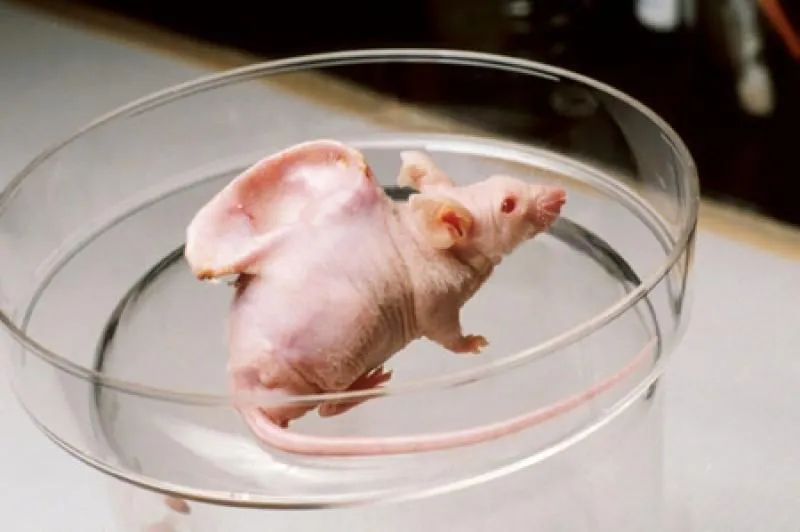
More than twenty years ago, 2 Harvard Academy medical researchers, Joseph and Charles Vacanti, led a team that successfully grew a human-ear-shaped piece of cartilage on the back of a lab mouse. The experiment used an ear-shaped mold filled with cartilage cells from a cow. The "ear" was first placed into an incubator, and once it began to abound, it was transplanted into the body of a nude mouse (a species of laboratory mouse with a genetic mutation that causes a degraded or absent thymus organ, inhibiting the animals' immune system and ability to reject strange tissues).
"Earmouse" or the Vacanti mouse, every bit the creature has get known, connected to abound the piece of tissue out of its back until information technology resembled the size and shape of a human ear. The team published their research in Plastic and Reconstructive Surgery in 1997. The experiment was designed to exam the viability of growing tissues for after transplant to human patients. And just final year, human children in People's republic of china suffering from a genetic defect called microtia, which prevents the external ear from growing properly, received new ears grown with their own cells—a like process to growing the "ear" on earmouse.
The mouse with a human ear on its dorsum may accept been one of the more than bizarre and visually unsettling experiments carried out on a rodent, but mice have been used for scientific experiments since around 1902, when a quirky and enterprising breeder named Abbie E. C. Lathrop recognized the animals' potential for genetic enquiry. The commencement use of rats in experiments started fifty-fifty earlier, with records dating back to the 1850s. Scientists purchased their subjects from professional person breeders known as "rat fanciers" who prized the creatures every bit pets for their unique coats and personalities. For decades, lab rats and mice have been used to make cracking scientific and medical advances, from cancer drugs and HIV antiretrovirals to the yearly flu vaccine.
Lab mice—most often of the species Mus musculus, or house mouse—are biomedical swiss ground forces knives, with genomes that are easily manipulated for genetic studies. The physiology of the human torso, however, is more closely mimicked in Rattus norvegicus, or the Norway rat, and its various strains. Rats are likewise easily trainable and perfectly suited for psychological experiments, especially because their neural networks so closely resemble our own. (In the 1950s and '60s, for case, researchers studying the biological underpinnings of curiosity noted that lab rats, devoid of whatever other stimulus or task, prefer to explore the unknown parts of a maze.)
Rats are besides much larger than mice and have thicker tails and blunter snouts. But it'southward the characteristics shared by mice and rats that make them both scourges of the urban center and the perfect scientific guinea pigs, and so to speak.
"They reproduce quickly, they are social, they are adjustable, and they are omnivores, and then they'll swallow pretty much anything," says Manuel Berdoy, a zoologist from Oxford University. Additionally, the rodents' diminutive size allows relatively easy storage in labs, and their shared evolutionary roots with humans mean the species' genomes overlap overwhelmingly.
As a consequence, rodents have all but taken over our labs, making up nearly 95 percentage of all laboratory animals. Over the by four decades, the number of studies using mice and rats more than quadrupled, while the number of published papers virtually dogs, cats and rabbits has remained fairly abiding. By 2009, mice alone were responsible for 3 times as many inquiry papers as zebra fish, fruit flies and roundworms combined.
Studies with rodents accost everything from neurology and psychology to drugs and disease. Researchers take implanted electronics into mice brains to control their movements, repeatedly tested the addictive properties of cocaine on mice, administered electric shocks to rodents as a negative stimulus, implanted human brains in mice skulls, and sent mice and rats scurrying through endless labyrinths of tests. NASA even keeps lab mice aboard the International Space Station for experiments in microgravity.
For all that lab mice and rats accept helped humans attain, the day-to-mean solar day experience of the animals takes place largely out of the public middle. But the life of lab rodents may be central to agreement and improving their function in the course of scientific discovery.
Scientists must complete animal handling and upstanding training before they are permitted to work with laboratory animals, though the rules vary depending on where the experiment takes place. While Canadian and European scientists are overseen by a national governing body, the rules in the Usa vary by institution with some overall guidance from the National Institute of Wellness. (The U.Due south. Animal Welfare Act, which protects nigh animals used for research, excludes mice and rats.)
Most universities offer a training course on how to handle the animals in a way to best reduce stress and suffering. The best practices have been updated over the years to reflect a irresolute understanding of the rodents and their needs. Afterward a 2010 study published in Nature showed that treatment lab rats by the tail causes more feet than guiding the animals through a tunnel or lifting them with cupped hands, labs around the globe abased the previously mutual technique.
Scientists who want to experiment with rodents are required to fill out a detailed application explaining why the work requires animal subjects. The applications are judged based on a framework known as the three R'south: reducing the numbers of animals used, replacing the utilize of animals when possible, and refining the experiments in social club to improve animal welfare.
"A rat or a mouse is not a test tube on legs," Berdoy says. Housing conditions for the rodents, for instance, has go a raison d'etre for lab animate being welfare proponents. About lab mice are kept in shoebox-sized cages (for rats, the space is almost doubled) with a few squeaky companions. And although having beau rodents satisfies the social needs of the animals, near laboratory housing lacks any sort of ecology enrichment objects to occupy the subjects. The size of their confinements also means they are restricted from natural behaviors like burrowing, climbing or even standing up direct.
Even though lab mice and rats are, at this indicate, genetically singled-out from their wild counterparts, they retain many of the same instincts. Repressing these needs could cause undue stress on the animals and compromise scientific findings. Berdoy'due south motion-picture show, The Laboratory Rat: A Natural History, details how lab rats released in the wild behaved and interacted in a similar way to their wild ancestors. Scientists, he believes, should consider the nature of rats when designing experiments to get the best results. "If you are going to do experiments," Berdoy says, "you need to go with the grain of biology rather than against information technology."
/https://tf-cmsv2-smithsonianmag-media.s3.amazonaws.com/filer/e5/99/e599284b-389a-4312-9a95-fe0dec989b11/feeding_a_laboratory_rat.jpg)
In some cases, the impacts of going confronting the biological grain take already been observed. While the genetic homogeneity of lab rodents helps to remove distracting variables from focused experiments, it may also, more subtly, exist skewing scientific results. In a 2010 written report on the impacts of intermittent fasting diets, Mark Mattson, main of the laboratory of neuroscience at the National Institute of Aging, observed that the positive neurological impacts that "metabolically morbid" lab rats derived from the diet government did not translate to healthy, active humans. The results were only applicable to "burrow potato" critters in a "bubble male child blazon scenario where … their immune systems are non being challenged with different viruses or bacteria." As Mattson succinctly notes, "What you discover may not be reflective of a salubrious animal."
In other words, the apply of static, homogenous, sheltered animals may not always be the best way to accomplish the ultimate goal of using lab rodents: to meliorate sympathise, and in some cases cure, the homo body and mind.
In general, the process of transitioning an experiment from rodents to humans is not haphazard. Besides the reams of paperwork, new drugs are required to be tested on two dissimilar animals—a small one, like a mouse or rat, and then a large one, usually a sus scrofa, dog or primate—earlier they move to human trials. Co-ordinate to the Pharmaceutical Research and Manufacturers of America, only one out of every 250 compounds tested on animals moves to human trials. For those that arrive to approval, the unabridged process usually takes 10 to 15 years.
Even after the long route to human trials, many drugs and procedures that work on mice and rats practise not piece of work on people. The rodents' "couch white potato" lifestyles could influence the results, or mayhap the slight differences betwixt rat, mouse and homo genomes produce unlike responses to drugs. In Alzheimer's studies, for example, mice and rats are artificially given a condition that resembles the disease considering they do not develop information technology naturally.
When a drug doesn't work, the results are oftentimes disappointing and costly, but sometimes mistakes can be tragic. Thalidomide, a drug used to treat morning sickness in the 1950s and 60s, caused deformities in human babies despite beingness successfully and harmlessly tested in rats. The drug breaks downward much faster in rats, and their embryos accept more than antioxidant defenses confronting its nastier side effects. In many cases, however, the reasons for a failed drug remain mysterious.
"This is one of the questions at the heart of medical enquiry. No ane has a good reply to it, and there may not be a good answer to it," says Richard Miller, a professor of pathology at the Academy of Michigan. "There are enough success stories that people are optimistic, but not everything that will work in the animals will work in people."
Whether an experiment will terminate successfully may exist uncertain, but one thing is always guaranteed: decease of the lab rodents. The body count is unavoidable; an estimated 100 million lab mice and rats or more are killed every year in U.S. labs for the sake of scientific discipline. While some of the bodies are creatively repurposed equally snacks for birds in sanctuaries, most are frozen and incinerated with the residue of the biological waste.
Rats and mice used in aging studies often live out their natural lives, merely virtually lab rodents are terminated at the end of a study. Some are killed via lethal injection or decapitated with strict guidelines to reduce hurting and suffering, but most often, they are suffocated in cages with carbon dioxide.
For some time COii has been considered the nearly ethical cease of life practice for these lab animals, but Joanna Makowska, adjunct professor at the University of British Columbia and Lab Brute Counselor for the Animal Welfare Institute, believes at that place is a better way. The carbon dioxide poisoning, she says, mimics the feeling of running out of air when you are holding your breath underwater, which causes undue fear and anxiety. "It's non a good death. Anesthesia is more humane, but people are non really doing that considering carbon dioxide is more practical and cheaper."
In general, Makowska believes researchers should exist making more of an attempt to meet the "reduction" principle of the iii R'due south. "That really should be the start R," she says. At Harvard, scientists fabricated an organ on a chip to assistance written report drugs and model disease without using animal subjects. Researchers have even developed computer algorithms based on thousands of creature trials that can accurately predict the style tissues will react to certain compounds.
But these lab rodent reduction-based advances have yet to take off, and the number of studies using the animals continues to grow. And while animal rights groups will raise hell over the handling of our other furry friends, the lab rat rights fight has yet to make a splash.
"I retrieve it comes down to how much we like them," Makowska says. "People invest themselves much more than in non-human primates. When it comes to dogs and cats, we have relationships with these animals. Nosotros are much more likely to admit that they suffer."
Afterward all, if a mouse or rat escapes the lab to the streets of the city, information technology is considered a pest; anyone tin can kill it with impunity.
Source: https://www.smithsonianmag.com/science-nature/history-lab-rat-scientific-triumphs-ethical-quandaries-180971533/
Posted by: brownthendre.blogspot.com
0 Response to "How Many Rats Are Used In Animal Testing"
Post a Comment