

Who Picks Up Dead Animals On The Side Of The Road

Ryan Delaney | St. Louis Public Radio
/
Nearly anyone who has driven has seen it: a dead animal on the side of the road. Fenton resident Jim Marshall was seeing a lot of dead animals last fall — especially deer — and it was beginning to bother him.
Then one twenty-four hours he noticed 2 deer on the side of Interstate 44 within a few hundred feet of each other.
"Ane was a doe, and quarter mile down was a buck," Marshall said. "By Friday, they were still in that location. I thought they would be picked up over weekend. But on Mon, they were withal there. However, someone came by over the weekend and cut off the head. I guess they wanted a bays."
The next day, the deer were gone.
The feel prompted Marshall to ask St. Louis Public Radio a question through our Curious Louis projection:Who cleans up roadkill, and what happens to it? And why did it take and so long to clean upwards those 2 deer?
The answer to that last question is that the Missouri Department of Transportation was likely very busy cleaning upward roadkill last fall and the crews weren't able to get to them in a timely mode. While all kinds of animals get hit, deer are the nigh common victims. What'south more, autumn is rutting flavour for deer, which means they have 1 thing on their mind — and it's not watching out for cars on highways.
According to MoDOT, the number of vehicles that kill deer in October and November is about three times higher than the rest of the yr.
Who does the deed?
The answer to Marshall's beginning question is rather straightforward. People call their local police or animal control department when they spot roadkill, and, if information technology's on a locally maintained street, then that municipality picks information technology up. If it's on a state road, and so MoDOT takes care of it. If it's in St. Louis County, information technology'south MoDOT's Southwest Customer Response squad.
Deon Morris and David Scales are two members of that team. Their job isn't simply to clean roadkill; it also includes patching potholes and trimming copse — anything that could be considered a run a risk. They say whatever the task, information technology's a treacherous job.
"Whether it's a highway or secondary road, this task is always dangerous," Morris said. "You lot never know who is distracted, what is going through their minds, what kind of day they're having.

Credit Ryan Delaney | St. Louis Public Radio
/
Morris said the key to staying safe while working is keeping your optics open, knowing your escape route and working speedily. "Do information technology and get out of there in sure time — no lingering around and making our chances greater."
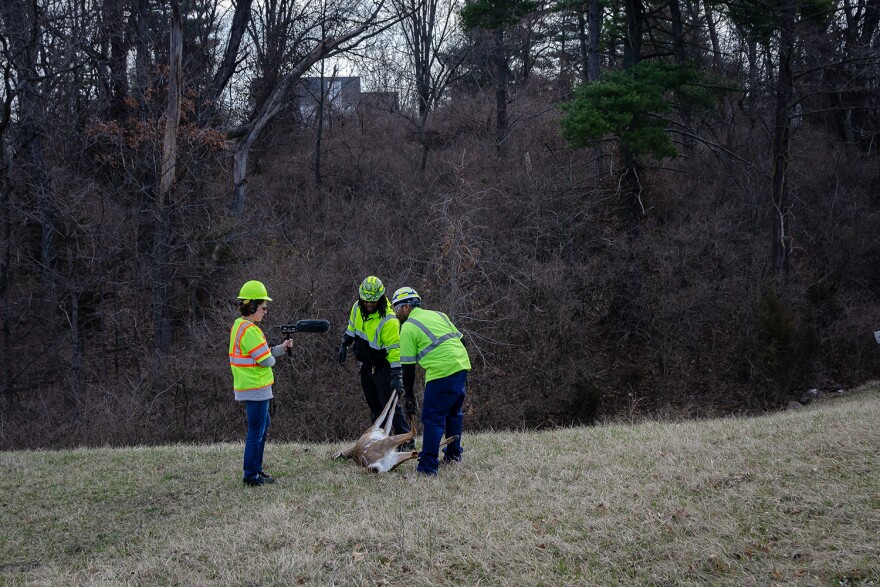
The attention to safety Morris and Scales possess extends to the job of picking upward a dead beast. On a crisp day in March, they received discover of a dead deer on Highway 141 near Carman Road in Manchester. They turn on their work lights as they dull down to notice the deer. Once they locate it, they don bright-yellow work vests and hard hats to improve their visibility to drivers.
The deer is non on the road itself but off to the side in the grass. It's a relatively small deer — Morris estimated it weighed about 80 pounds. Before picking it upwards, Scales gently nudges the animal with his foot.
"You still desire to bank check the deer out because opossums feed on them, and if you come and take hold of 1 as well speedily, 1 may run out," Scales said. He too said it's of import to check the deer for ticks or other infestations.
In one case they determine it'southward condom to handle, the men pick the deer up by its legs and acquit information technology to the truck. They lay it on a metal trailer on the back of the truck. The deer isn't secured to annihilation, but the sides of the trailer lock down like a basket to ensure the animal tin can't autumn out. Scales and Morris triple-check that the gates are secure earlier walking astern — facing oncoming traffic — to get dorsum in the truck.

Credit Ryan Delaney | St. Louis Public Radio
/
On that day, the deer carcass didn't aroma particularly bad. For i thing, Morris said, it was cold out, which helps minimize the smell. Also, it hadn't been expressionless that long. He knew because the natural language was notwithstanding soft — it hadn't hardened yet. And there was no green coloring around the abdomen. Morris also pointed out the optics.
"If it's more of a milky-looking, cloudy white; it'south been out here a while," Morris said. "This deer's eyes haven't dilated; it'south nonetheless regular. It probably got killed early this forenoon."
When an animal has been dead for a while, and it's a hot summer day, Morris said the stench can be powerful. On those days, they dab Vicks VapoRub under their noses to block the smell.
What happens to roadkill?
There are options for how to dispose of roadkill. About ordinarily, carcasses are taken to an incinerator where they're burned and forgotten. But several animal sanctuaries, including the Endangered Wolf Centre and the Earth Bird Sanctuary, have the bodies. They butcher the dead deer, store them in giant freezers and feed them to their carnivores.
There have been times, in the course of picking upwardly roadkill, that Morris and Scales have interrupted carnivores snacking on the carcasses in the wild. Vultures went after Scales once when he tried to pick up a deer. And Morris has firsthand experience with coyotes.
It was late on a Friday when a call about two dead deer came in. The crew had time to pick the bodies up but not to dispose of them. So they covered them upwards with a tarp and secured information technology, thinking they would accept finish the job the following Monday.
But on that day, Morris said, he was preparing his truck to make sure it was condom for work when he noticed something modest and gray running abroad from the parking lot.
"I didn't know what it was, just I knew I had put two deer right there," Morris said.
At present there was just ane.
"So when I grabbed it and started dragging it to the truck, so that little grey thing I saw came on top of the colina. He was looking at me. I thought information technology was a baby wolf," Morris said. "Then three more came up. I was like, 'What do I do at present?' I'k standing here with this deer on this truck, looking at those coyotes. Showtime thing I thought is, if they run toward me, I'thou hopping in this truck, and I'm driving out. And if they follow me, so I'll exit on the highway and hopefully they'll get hitting."
Once he started moving, they all ran abroad.

Credit Ryan Delaney | St. Louis Public Radio
/
For the most part, withal, dead animals — be it deer, turtles or armadillo — are removed from roads and disposed of as apace every bit possible.
Scales and Morris both said the task was a little hard at first, but they have acclimated. Morris said he sees most animals and recognizes them equally only a shell of what was one time there. The only time he pauses, is when the animal is a canis familiaris.
"I'm a dog lover," Morris said. "Then when you see a dog, it taps into the vulnerable side. I typically take to take a second to look and get past the fact that this is my job."
Morris said he takes condolement in knowing that for dogs, they aren't automatically taken to the incinerator. The MoDOT crew always try to contact the owners so they tin can meet their pets and have their last goodbyes.
Despite the sad moments, Morris and Scales said they are genuinely happy in their jobs. They're serving the public, which means a lot to them and their families.
"I become to help people. Whether it's doing a pothole or just calling a client back. Just knowing we actually helped someone, I am 100% comfy with that."
Credit Ryan Delaney | St. Louis Public Radio
/
Follow Shula on Twitter: @shuneu
Source: https://news.stlpublicradio.org/arts/2019-04-23/curious-louis-answers-who-cleans-up-roadkill-and-what-do-they-do-with-it
Posted by: brownthendre.blogspot.com
0 Response to "Who Picks Up Dead Animals On The Side Of The Road"
Post a Comment